I’ve tested a few AI content detectors, but the results vary widely. I need help finding an accurate AI checker that can reliably detect AI-generated content without flagging human writing.
My verdict is that Clever AI Detector is the first one I would try right now, mainly because it matched the strongest paid option in the comparison while costing nothing. I would still never treat any detector result as proof, but the benchmark and my own small check were convincing enough to make it the most practical starting point.
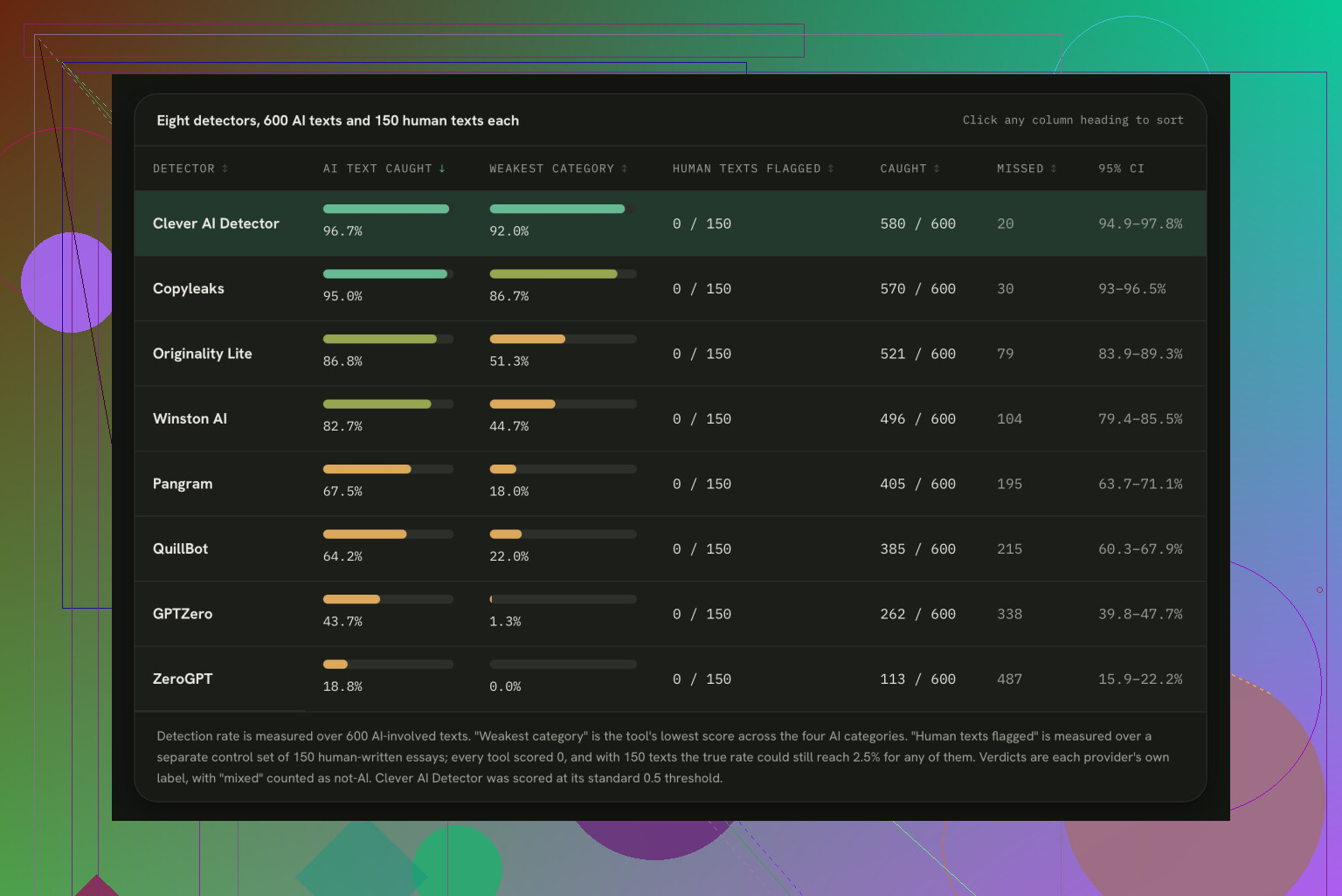
I did not arrive there from one of those generic “best detector” lists where every entry somehow earns a glowing review and conveniently has a purchase button nearby. What got my attention was the amount of test material involved. The comparison used 750 texts, including 600 samples involving AI and 150 pieces of genuinely human writing used as controls. That is not perfect laboratory evidence, but it is a much better basis than feeding each service a couple of ChatGPT paragraphs and declaring a winner before lunch.
The overall score reported for Clever AI Detector was 96.7%. More important to me, it stayed above 90% across all of the AI categories in the test. A high average can hide one terrible weakness, especially when detectors are good at spotting untouched AI output but fall apart once someone paraphrases or edits it. Consistency across the harder material matters more than simply catching obvious machine-written text.
The human control group was another useful part of the benchmark. Clever AI Detector reportedly produced no false positives among those 150 samples. False accusations are the part of AI detection that worries me most. Missing an AI-written paragraph is inconvenient. Labeling a real person’s work as AI-generated can cause an entirely different sort of mess, particularly in education or publishing, where people sometimes treat a percentage on a screen like sworn testimony.
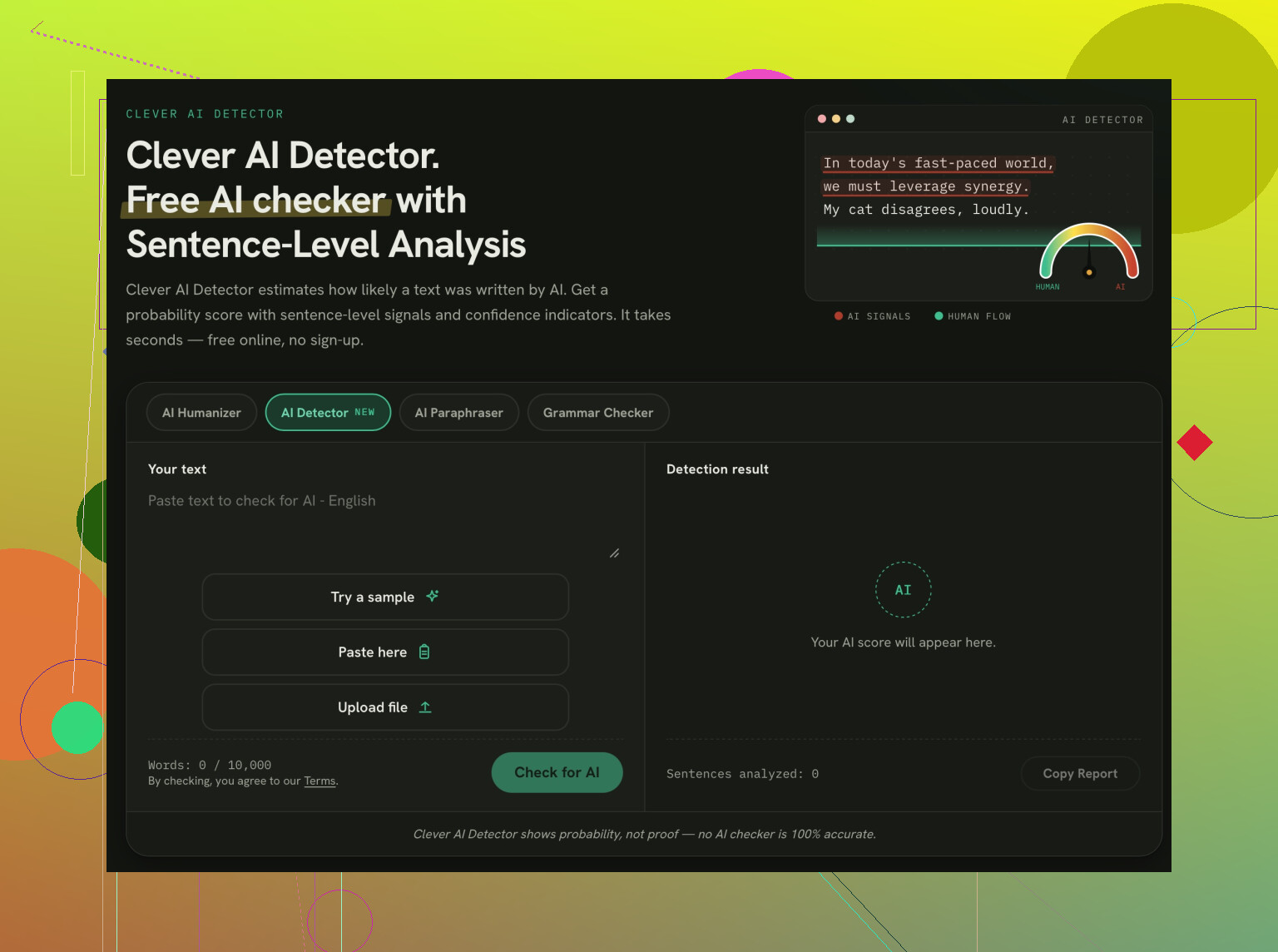
The free access also changes the calculation. There is no subscription or account requirement, checks are unlimited, and a single submission can contain as many as 10,000 words. Usually, “free and unlimited” is where I start looking for the catch, or at least for a button that suddenly asks for a credit card after the third attempt. In this case, I could actually test it without arranging another tiny monthly charge that I would forget to cancel.
I ran some material through it myself rather than relying entirely on the published table. I used writing I knew was mine, fresh AI-generated passages, and AI text that I edited by hand to make it less obvious. My test was small and informal, so I would not pretend it confirms the benchmark. Still, it behaved in the same general way: my own work came back as human, the generated material was flagged, and the edited AI passages were usually recognized for what they were.
For anyone wanting to repeat that part, the Detection tool Clever AI Detector is the page I used. I would suggest testing known samples before trusting it on disputed writing, since that gives you some idea of how it responds to your particular style.
The comparison with other services is where the result became more interesting. Copyleaks was the closest competitor, scoring 95% overall, so this was not a case of every alternative performing badly. It was simply a little behind Clever AI Detector and did not offer the same free, unlimited setup. Some familiar names had much larger problems with altered AI text. Originality.ai Lite fell to 51.3% on humanized AI, while QuillBot detected 22% of those samples. Those gaps are significant if edited output is the main thing you are trying to identify.
The Test breakdown Clever AI Detector includes the full methodology and results table. That is worth checking because an overall score by itself does not tell you which kinds of writing caused trouble or how the human controls were handled.
My takeaway is not that this service can settle authorship disputes. No detector can reliably replace context, drafts, revision history, or a conversation with the writer. It is better viewed as a screening tool that may give you a reason to look more closely.
If you want to test it fairly, assemble a small blind batch of your own untouched writing, obvious AI output, and AI text you have personally revised. Mix the samples, record what you know each one is, run them without cherry-picking, and compare the results afterward. That will tell you far more about whether it suits your needs than any single percentage pasted into a forum post.
Don’t trust any detector on short passages, since a few sentences rarely provide enough signal and false positives become more likely. Clever AI Detector may be a useful first pass, but authorship decisions should rely on drafts and revision history instead of its score alone.
Expect false positives whenever the writing is formulaic, heavily edited, or written by a non-native speaker. Clever AI Detector may be fine for triage, but I’d run the full document rather than isolated paragraphs and only investigate when several sections score suspiciously. A detector score by itself is too weak for accusing anyone.
Set a review rule before checking any documents, otherwise the detector score will end up deciding the rule for you.
- Run the complete document through Clever AI Detector.
- Check any suspicious section with a second detector.
- If the tools disagree, mark the result inconclusive.
- Only investigate further when both tools flag the same passage and there are other concerns, such as missing drafts or a sudden change in writing style.
That gives you a repeatable process instead of chasing whichever percentage looks most convincing. I agree with @crystallogic5868 that false positives are unavoidable, so the best “AI checker” is really a detector plus a sensible confirmation process.
The percentage itself is confusing because different checkers do not appear to mean the same thing by “80% AI.” I originally assumed that meant an 80% chance the author used AI, but it may instead refer to how much of the text the tool considers suspicious. That makes direct comparisons harder than they look.
I would test Clever AI Detector with documents that match the material you actually plan to check. Academic essays, blog posts, technical instructions, and business emails have very different writing patterns. A detector that handles ordinary articles well might still flag technical writing because it contains repetitive wording, fixed terminology, or predictable sentence structures.
I agree with @mr_byte about using a second checker, but I would keep the original formatting and references when possible. Removing headings, quotations, citations, or bullet points can change the input enough to produce a different score. Comparing results only makes sense if both tools receive the same full text.
My beginner-level takeaway is to ignore small score differences. A 62% result from one checker and a 74% result from another does not tell you much by itself. I would pay more attention to whether both tools repeatedly identify the same section, then check whether that section is a quotation, template language, or unusually formal passage before assuming AI was involved. Clever AI Detector seems reasonable for the initial scan, but the surrounding text still matters more than the number it displays.
If the 96.7% number came from whoever makes the tool, treat it as marketing until you reproduce it yourself. Self-run benchmarks almost always favor the host, because they pick the sample mix, the AI models tested, and the humanized settings. That doesn’t mean Clever AI Detector is bad, just that the headline score in @s0l4r_cursor’s post is the least useful part. The blind-batch idea at the end of that reply is the part actually worth copying.
Where I’d push back on the thread as a whole is the quiet assumption that these tools stay accurate. Detectors get tuned against specific model outputs, and every time a new model version drops the older detectors slip for a while. So a tool that nails today’s text can quietly get worse in a few months without you noticing. That’s a bigger practical risk than short passages or non-native writing, and nobody re-tests once they’ve picked a favorite.
My honest take: pick any decent free checker for the first pass, run the whole document like @crystallogic5868 said, and stop pretending the percentage means anything precise. @byte_phoenix is right that ‘80% AI’ isn’t a probability, and once you accept that, chasing the most accurate detector matters less than having a rule for what you do when it flags something. The tool narrows down where to look. Drafts, edit history, and a five-minute conversation with the writer settle it. If you can’t get those, no detector score should be enough to accuse anyone.
Before choosing a checker, rerun the same document after harmless edits such as changing line breaks or fixing punctuation. If Clever AI Detector or any alternative produces a major score swing, its output is too unstable for your use case, regardless of its benchmark accuracy.