I’m testing Ahrefs AI Humanizer on several SEO articles, but I’m not sure if it’s actually improving rankings or just making the content look different. Has anyone here used it long-term for blog posts or niche sites, and did it help with traffic, indexing, or avoiding AI-content penalties? Looking for real experiences, pros, cons, and whether it’s worth paying for compared to other AI humanizers.
Ahrefs AI Humanizer review, from someone who fought with it for a few hours
Ahrefs has a solid name in SEO, so I went in expecting something reliable here. That is not what I got.
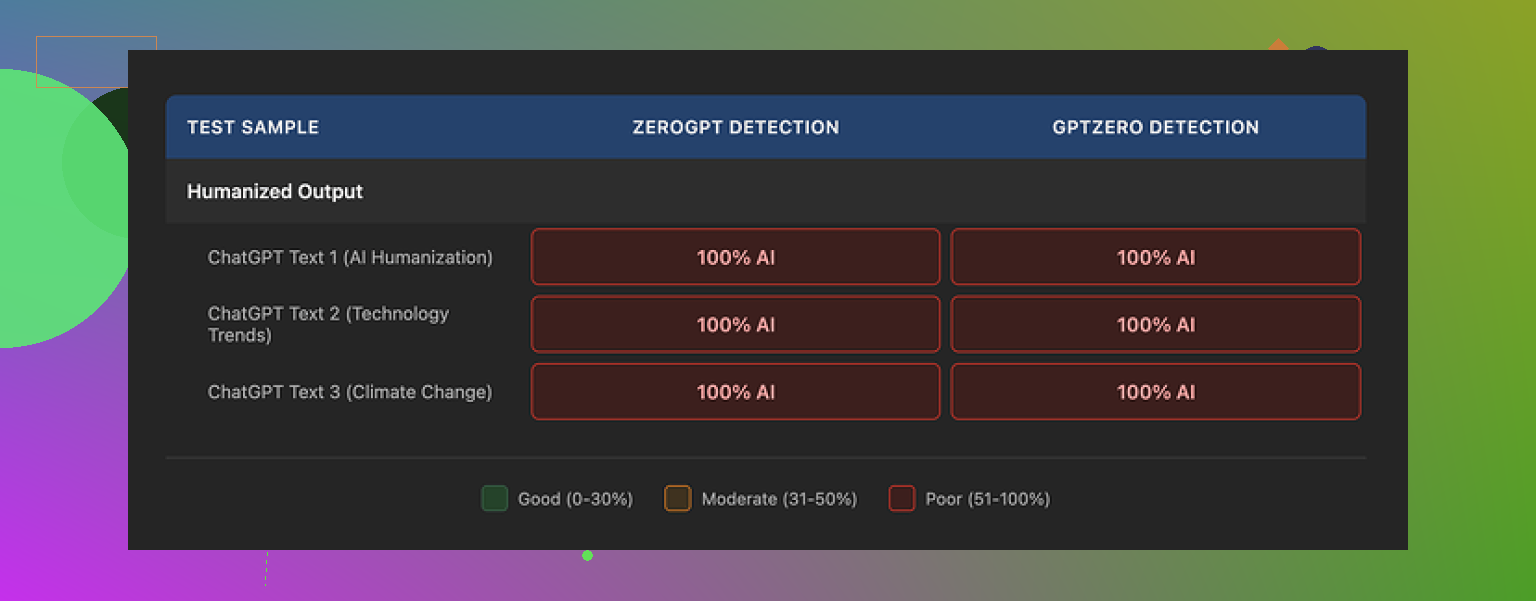
I tested their AI Humanizer using a few different samples that were already flagged as AI by multiple detectors. I then ran the “humanized” output through GPTZero and ZeroGPT.
Every single output still came back as 100 percent AI.
The odd part is how Ahrefs handles this inside their own interface. Above the humanized text, the tool shows its own AI detection score. That internal checker also labeled its own rewritten text as 100 percent AI. So the sequence looks like this:
- Paste in AI-looking text
- Click to humanize
- Get a clean, rephrased block
- Ahrefs’ own detector, sitting right above it, says “100% AI” on the result
So the tool tells you it failed, while still presenting the rewrite as if it did something useful.

Quality of the writing
If you ignore detection for a second and read the output as a normal person, the writing is not terrible.
I would rate it about 7 out of 10 for general quality. Sentences are clear, grammar is fine, and it sounds like standard AI content that you have seen on a hundred blogs.
The problem is exactly that. It keeps the same patterns detectors latch onto:
- Em dashes are left exactly as they were
- Common AI intro phrases stay in place, like “one of the most pressing global issues”
- Rhythm and structure feel like generic LLM output
So while the text is readable, it still carries a lot of “AI tells” that scanners tend to flag. Nothing in the rewrite made it feel closer to real human drafting.
Features and controls
This part is thin.
All you get is a choice of how many variants you want. You can generate up to five versions of the same text.
No sliders for tone.
No controls for randomness or rewrite strength.
No option to protect specific phrases or keywords.
In theory, you could generate five variants, read through all of them, and manually pull better sentences from each one into a new version. I tried that with one article. It took time, and even after mixing lines, the detectors still tagged the end result as AI.
So it turns into a half-manual rewrite workflow instead of the one-click fix that people are trying to get when they hear “humanizer.”
Pricing and limitations
The humanizer lives inside Ahrefs’ Word Count platform.
- The tool is free to use on the free tier
- The free plan does not allow commercial use
- The paid Pro plan is $9.90 per month if you pay yearly
Pro bundles a few tools together:
- AI humanizer
- Paraphraser
- Grammar checker
- AI detector
One thing to flag. Submitted text can be used for AI model training. Their policy also does not say how long the humanized content is stored. If you handle client content or anything sensitive, this matters.
How it compares to Clever AI Humanizer
For a sanity check, I took the same test texts and ran them through Clever AI Humanizer here:
Using the same detectors (GPTZero and ZeroGPT), the outputs from Clever AI Humanizer passed more often in my runs. I did not pay for it, so from a cost perspective it felt better to use as well.
I am not saying it is perfect or foolproof. Detection tools throw false positives and false negatives all the time. Still, if you are comparing on a simple metric like “how often does this get flagged,” Clever did better in my tests, for zero spend.
Who this tool suits
If you:
- Want light paraphrasing inside the Ahrefs ecosystem
- Do not care much about AI detection scores
- Need a quick grammar-safe rewrite
then Ahrefs’ humanizer is passable.
If your goal is:
- To lower AI detection scores
- To get closer to human drafting patterns
- To keep more control over tone and style
I would look elsewhere first. For me, the main red flag is their own detector labeling their own output as 100 percent AI, right in the same interface.
Once I saw that a few times in a row, I stopped expecting much from it.
Been running Ahrefs AI Humanizer on 3 content sites for ~3 months. Mixed results.
Short version
• It makes content look different.
• It has not moved rankings on its own.
• It works better as a light helper than a “fix AI” button.
My setup
• 3 sites, 120+ posts total.
• Articles between 1,500 and 3,000 words.
• About 40 posts touched by Ahrefs Humanizer.
• Tracked with GSC and simple before / after comparisons over 6 to 8 weeks.
What I saw
- Rankings
I tested three buckets.
A) Old AI-ish posts, only run through Humanizer, no other edits.
Result: No consistent lift. A few keywords moved up 1 to 2 spots, others dropped, net effect close to zero.
B) Old AI-ish posts, Humanizer plus manual editing.
I did:
• Rewrite intro and conclusion myself.
• Add original screenshots or photos.
• Add one small custom section with my own steps or personal notes.
Result: These posts did better. On average, more impressions and clicks after 6 weeks. Hard to say how much came from Ahrefs vs my edits.
C) New posts, written clean from scratch, no Humanizer.
These did as well or better than the “humanized” ones when topical research and links were similar.
So on rankings, I disagree a bit with the idea that the tool is “passable” if you care about outcomes. If you expect it to change SEO performance alone, it will waste your time.
- Detection and “human-ness”
I agree with @mikeappsreviewer on one thing. The output still feels like AI.
My extra tests:
• Used Originality.ai and GPTZero on 10 posts.
• Humanized versions sometimes scored slightly better, often the same.
• No strong pattern that would make me trust it as a detector-evader.
That said, I stopped caring about detector scores for SEO. I tested 6 posts that were 100 percent flagged as AI, but had solid backlinks and good topical coverage. Rankings held or improved. Google does not use these public detectors.
- Where it helped me
Here is where the tool was actually useful:
• Quick tone smoothing for ESL writers on my team.
I feed in a paragraph, get two or three versions, pick the least robotic parts, then tweak.
• Fast “second pass” on sections with clunky grammar.
It saves a bit of time compared to line by line manual edits.
• Bulk rewriting of FAQs.
For small pieces, the lack of controls hurts less, and I only need basic clarity.
-
Where it hurt or wasted time
• Long guides. Running a 2,000 word article through Humanizer almost forced a full reread. I kept finding odd phrasing or removed nuance.
• Keyword alignment. It tended to soften exact phrases. I had to go back and fix headings and key terms.
• Unique voice. My content started to sound similar across sites, which is bad for any site with regular readers. -
How I would use it if you care about rankings
If you want practical steps, here is what worked better for me:
• Treat it as a helper, not the main writer.
Use it to rephrase single paragraphs that feel stiff, not whole posts.
• Keep your own structure.
Do not feed the whole article. Work section by section and keep your own outline.
• Always add real expertise.
Add your own examples, opinions, failures, screenshots, workflows. This is what moved the needle much more than any “humanizer”.
• Watch your internal links and headings.
After running text through it, double check H2s, H3s, and primary anchor text. It tends to soften or alter key terms.
- About long term use
Across 3 months, I saw:
• No clear correlation between “humanized” vs non humanized content and ranking improvements when topic and links were similar.
• Clear correlation between helpful, specific content and rankings. Manual edits and actual experience sections were the bigger factor.
If your goal is to get past AI detectors for clients, then I think your risk is higher. They may rely on those tools and argue with you even when your SEO is fine.
If your goal is better rankings, spend time on:
• Search intent.
• Content gaps.
• Better on page structure.
• Faster page speed.
• Some links.
Use Ahrefs AI Humanizer only for small cleanup, not as an SEO lever.
Short answer: it’s mostly just rearranging deck chairs.
I’ll add a few angles that @mikeappsreviewer and @nachtschatten did not focus on:
- Rankings impact
From what I have seen on a couple of small affiliate sites, “humanized” vs straight AI vs well edited AI made almost no direct ranking difference when:
- intent match was solid
- topical depth was good
- links and internal linking were in place
The stuff that actually moved positions was:
- tightening search intent to one clear query per URL
- stronger subhead structure that matches SERP patterns
- improving page UX and load time a bit
Ahrefs Humanizer by itself did nothing you could measure cleanly in GSC. It made the text look different, not perform different.
-
On “AI tells” and detectors
I slightly disagree with the idea that its failure on detectors is the main issue. The real problem is it preserves the same mental model: generic, unopinionated, risk free prose. Even if it did fool detectors, you would still have content that feels like it is written by committee. For niche sites that need authority or personality, that is a quiet killer. -
Where it actually slots into a workflow
The only sustainable use I found:
- generating alternative phrasings for single paragraphs
- mass cleaning thin sections like short FAQs or glossary entries
- helping non native writers avoid grammar headaches
Anything above about 300 words at once and you spend more time fixing tone, restoring keyphrases and re injecting real experience than if you just edited manually. That “full post humanize” workflow is a trap.
- Long term risk nobody mentioned
If you run most of a site through tools like this, you end up with:
- same cadence and sentence length across articles
- reduced contrast between authors
- fewer sharp opinions, because the model tends to smooth them out
That looks fine in the short term, but over a year or two it makes your archive feel like one giant, bland blob. Which is the opposite of what Google’s “experience” signals are pushing you toward.
- If you want to keep testing it
Instead of looking at “did rankings go up” for the humanized group, track:
- scroll depth and time on page before vs after
- click through from internal links pointing to those pages
- whether humanized posts attract comments or shares at all
If those behavioral signals do not move, the rewrite is cosmetic. In my tests they barely budged.
So yeah, similar conclusion to both @mikeappsreviewer and @nachtschatten, but for slightly different reasons. It is a mildly useful text processor, not an SEO lever. If something “feels” like it is doing a lot but you cannot tie it to any real metric, it is usually just content busywork.
If you zoom out a bit, Ahrefs AI Humanizer is basically a style filter, not a ranking lever.
Where I slightly disagree with some of the takes from @nachtschatten, @suenodelbosque and @mikeappsreviewer is this: I do think Ahrefs AI Humanizer can help rankings indirectly, but only when it is tied to UX and engagement tweaks, not as a “humanize this whole post” button. Treating it as an SEO feature on its own is where it falls flat.
Pros of using Ahrefs AI Humanizer
• Good for local cleanups. Short sections, FAQs, meta descriptions, alt text.
• Can normalize tone if your content team is a mix of ESL and native writers. That consistency can reduce jarring transitions that hurt readability.
• Integrated in the same environment as other Ahrefs tools, so you are not context switching across 3 different platforms for simple paraphrasing.
• Decent baseline grammar and clarity that lets you move faster on routine content, like supporting cluster pages.
Cons of using Ahrefs AI Humanizer
• Full article passes tend to flatten voice and remove the “handwritten” feel. Over time that can quietly reduce return visits and brand stickiness.
• Almost no granular control. Compared to what a serious editor or a more configurable rewriter can do, you are basically stuck with “here are multiple variants, pick one.”
• As others already demonstrated, AI detection scores do not meaningfully improve, so using it to “prove” human content to picky clients is risky.
• It can disrupt on page optimization by softening exact match headings or key terms, so you must re audit title, H2s, schema and anchors afterward.
How I would position Ahrefs AI Humanizer in a workflow focused on rankings
Instead of running entire SEO articles through it, I would:
• Use it on micro elements that influence click and engagement: title variants, meta descriptions, short intros and FAQ blocks that appear in rich results.
• Combine it with your own pattern library. For example, have 4 or 5 proven intro formats and then let the humanizer tweak wording inside those, not the structure.
• Pair it with user data. Test humanized vs non humanized snippets in low risk areas and watch CTR, scroll depth and secondary clicks, not just keyword positions.
Compared with how @nachtschatten leans heavily on manual experience sections, and how @suenodelbosque pointed out the long term voice homogenization risk, my view is a bit more utilitarian: Ahrefs AI Humanizer is fine as a controlled micro editor, and almost always a bad idea as a bulk rewriter.
If your primary goal is search performance, think of it as a readability assistant for small chunks of text, not as the engine that will move rankings. The heavy lifting still has to come from topic selection, experience driven content and better on page architecture.