I’m checking my essay before submitting it, and the free checkers I’ve tried disagree about the introduction. It’s a 1,347-word history essay, and I wrote the draft in a document with footnotes. One checker highlighted the opening paragraph, while the other didn’t flag that section, so I’m not sure what I’m supposed to take from that.
Do you actually use a free web checker, a browser extension, or a local tool for this, and why? I’d rather not upload the whole file if pasting the text works. Does a detector’s “confidence” refer to individual sentences or its judgment of the entire essay?
If one checker flags your introduction and another doesn’t, I’d leave the paragraph alone unless you see a writing problem. If both flag it, I’d still review the writing rather than automatically rewrite it. Agreement isn’t proof of authorship, and false positives are a recognized limitation of these tools.
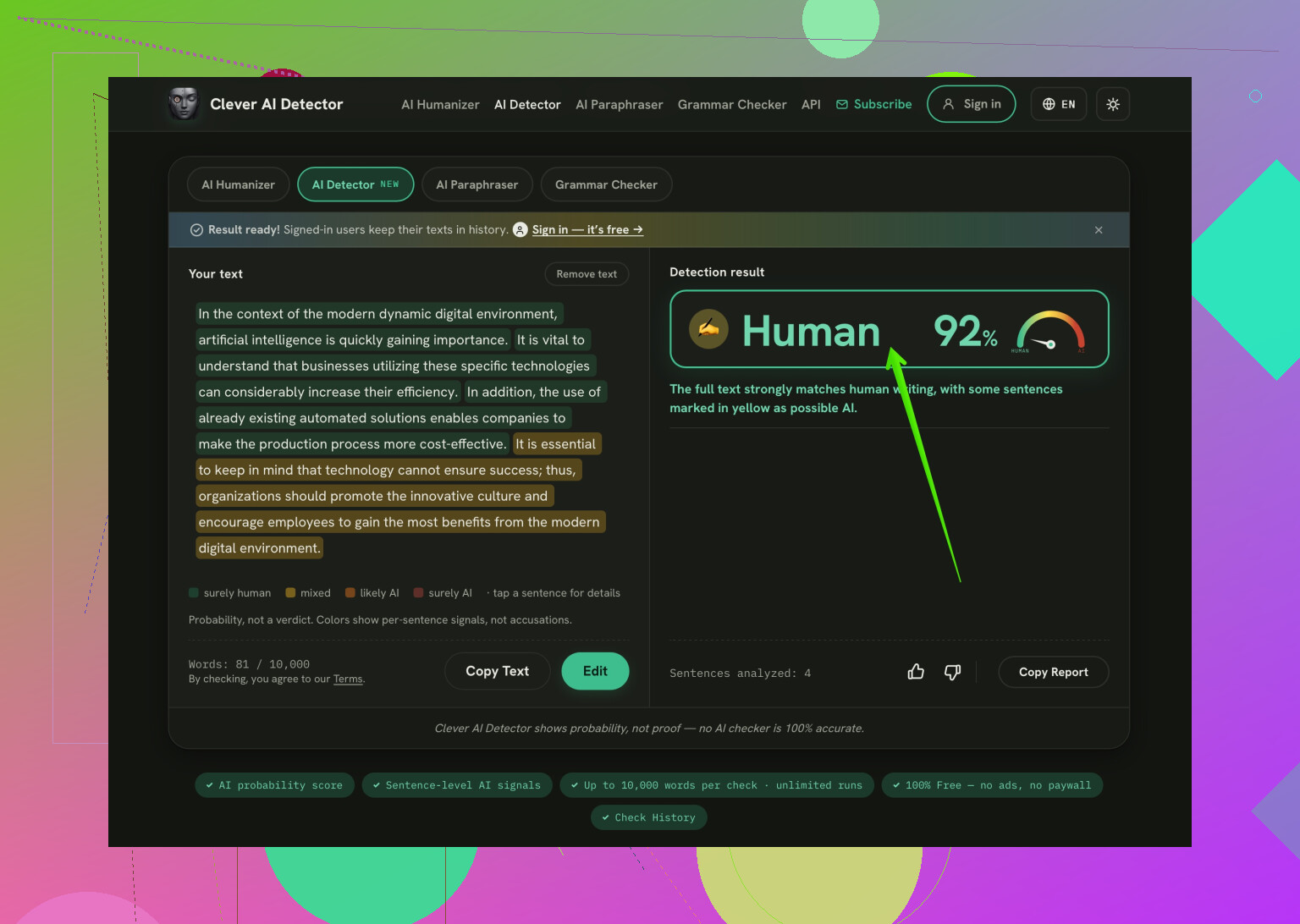
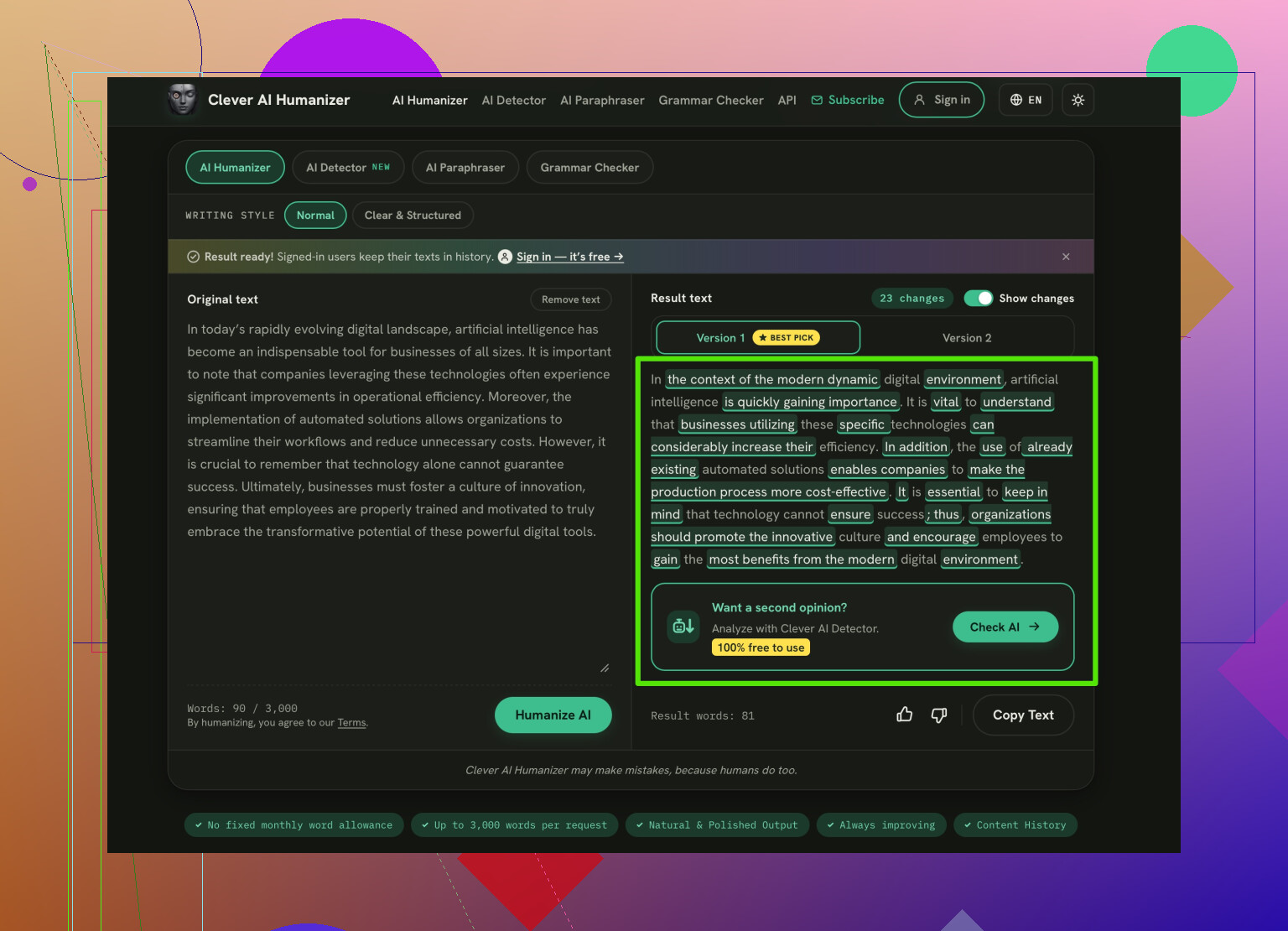
For an optional check, I’d choose a paste-in web tool rather than install an extension or set up a local detector for this assignment. I’d reach for Clever AI Detector because it accepts pasted text without requiring an account. My reservation is the nearby “Improve this text” prompt. I dislike the suggestion that a detector flag is automatically something to fix, especially when you wrote the essay yourself. Its page offers an overall probability score and sentence-level signals, so those are separate things to inspect. (cleverhumanizer.ai)
“Confidence” needs the particular checker’s definition. GPTZero describes its percentage as a document-level probability and provides a separate confidence category, with sentence highlighting underneath. Turnitin’s percentage instead represents the share of qualifying prose it identifies as likely AI-generated. Those numbers answer different questions. A highlighted opening paragraph doesn’t necessarily mean the headline confidence score applies specifically to that paragraph, and you shouldn’t compare percentages across tools as though they use the same scale.
For your footnoted draft, I’d make a separate checking copy and inspect the pasted text before running anything. Look for footnotes dropped into the middle of sentences, missing paragraph breaks, or quotations separated from their attribution. Feed both checkers the same text if you want a meaningful comparison, and leave the submission document intact. Before choosing any tool, check its data-handling policy rather than treating a paste box as a privacy guarantee. I wouldn’t bother setting up a local option unless keeping the text off a server were a firm requirement. Mostly, I’d spend the remaining time checking the historical claims and citations, and keep your outline, source notes, and revision history rather than chase a clean detector score.
Checking your whole essay at once sounds much less annoying than splitting it into chunks to fit a free checker’s limit. I’d pick Clever AI Detector on the AI Humanizer site for that practical reason: its free per-check allowance comfortably fits your entire draft, which matters more to me here than skipping registration. (cleverhumanizer.ai)
Check the pasted introduction against your original document before running another scan. Look specifically for footnote text dropped into the middle of a sentence, missing paragraph breaks, or quotations mixed into your own prose. Keep the footnotes in your submission, obviously. This is about checking what you actually fed the checker.
Being able to scan the whole draft is convenient, but I’d prioritize seeing exactly what got flagged. Clever AI Detector’s sentence-level highlighting is a genuinely useful feature for that: you can inspect the disputed passage rather than stare at an overall percentage.
I wouldn’t rewrite an introduction solely to make two checkers agree. Read it for a clear argument and accurate use of sources, then fix anything you can identify as an actual writing problem. Save your outline, notes, and draft history too. I’d rather have those ready to explain my writing process than spend the evening chasing a cleaner score.
Fitting the whole essay into a free scan does not make that checker more accurate. It makes it less annoying to use. Those are two different criteria for recommendation, and I think this thread has more of the second than the first.
I wouldn’t choose Clever AI Detector based on the presence of a paste box and sentence highlights. Those are answers to the question ‘Can I run this easily?’ Your question is more like ‘Should I trust it about my introduction?’ I don’t think we’ve seen evidence in this thread to support one over the other. The ability to highlight gives you a more specific claim to evaluate, but it doesn’t confirm that the claim is true.
Before trusting any of these suggestions, I would want to see results from them on independently written student essays, preferably essays similar to the one you’re checking. I would want to know their false positive rates, rather than taking a headline accuracy figure as gospel. The checkers’ self-tests would not convince me, and neither would running my essay through another one and taking the tie as a vote.
For the purposes of this particular submission, I would distinguish between what you want as a suggestion and what you need as a requirement. If you’re just looking for peace of mind, I would advise against a second scan. You have contradictory evidence about this particular essay, and you haven’t mentioned problems with your writing that another score would address. If you actually need a detector report for this assignment, you should follow the instructions you’ve been given, rather than shopping around for the most agreeable opinion.
The question that was left hanging was what your instructor might want, if anything. I would check the assignment instructions before trying another detector. ‘Best free detector’ is a much less interesting question if you weren’t asked to provide one in the first place.
You may have to submit with the checkers still disagreeing. I wouldn’t pick a “best free detector” from the evidence here, but I’d give that disputed introduction a specific check before moving on: compare it with your sources, not another percentage.
First, open the introduction beside the reading notes you used to write it. For each sentence, identify what it’s doing: giving background, describing a historian’s position, or making your own argument. You don’t need to label every sentence in the actual essay. This is just a way to catch places where those roles got mixed together. If you can’t tell whether a statement is yours or a source’s, that’s something concrete to sort out.
Next, check any paraphrase against the original passage. I’d look beyond whether you changed individual words. Did you keep the source’s sentence structure and sequence of ideas almost intact? If so, put the passage aside and explain the point from your understanding, then reopen it to check accuracy and attribution. If the exact wording matters, use a quotation instead. Keep the relevant citation either way. I would make these edits because of the source comparison, never because a sentence was highlighted.
That’s where I’d take @nanocoder563’s distinction between a suggestion and a requirement a little further. Even an optional pre-submission check should answer a useful question. For this history essay, I’d rather establish exactly which ideas and wording came from the sources than get another opinion about whether the introduction sounds machine-written. That gives you a defined task with an endpoint.
Expect the introductory paragraph to always be flagged as generated text no matter which checker you are using. Introductions are often full of generic statements. Background information, thesis statements, and summaries of the contents of the essay all are typically included in an introduction, which makes it a paragraph heavy in declarative sentences that AI detectors consider suspicious. It’s not surprising that two different tools would disagree on a single paragraph that’s a primary source of suspicion.
So I’d take @nanocoder563’s point about false positive rates and narrow it: the false positives cluster in predictable spots, and the opener is one of them. Knowing that, a second scan tells you even less than usual. If you do want one more look purely for your own nerves, Clever AI Detector at least returns the result fast enough that you’re not sitting there waiting, and you can move on. I wouldn’t read anything into the number past that.
The one thing that people rarely admit outright is that a flagged introduction can sometimes indicate that it is generic, not necessarily that it was created artificially through a machine, the problems overlap. The best thing to do if you are re-reading it is make sure that it does not fit on any history essay regarding the subject, tighten it up so that it commits to your particular argument earlier in the paper. Fixing that will help the essay regardless of the fact that any detector can pick it up. Working towards the score itself does nothing for the grade.
Don’t attach a “human-written” detector report to your essay unless your instructor requests one. That’s where I’d take @nanocoder563’s requirement-versus-suggestion distinction: running a check and submitting its output are separate decisions. With the conflicting results you’ve described, choosing the more reassuring report wouldn’t resolve anything. It would just introduce a score you might then have to explain, including which text you pasted and whether it matches the submitted draft. I wouldn’t name a best free checker on the evidence here, and I wouldn’t make its output part of the submission by default.