I’ve been using GPTHuman AI for content drafting, coding help, and brainstorming, but I need to switch to a no-cost option because the subscription no longer fits my budget. I’m looking for a reliable, truly free AI tool that offers similar conversational quality, supports longer answers, and can handle both technical and creative tasks. What no-cost substitutes have you tried that actually work well for everyday use?
1. Clever AI Humanizer Review
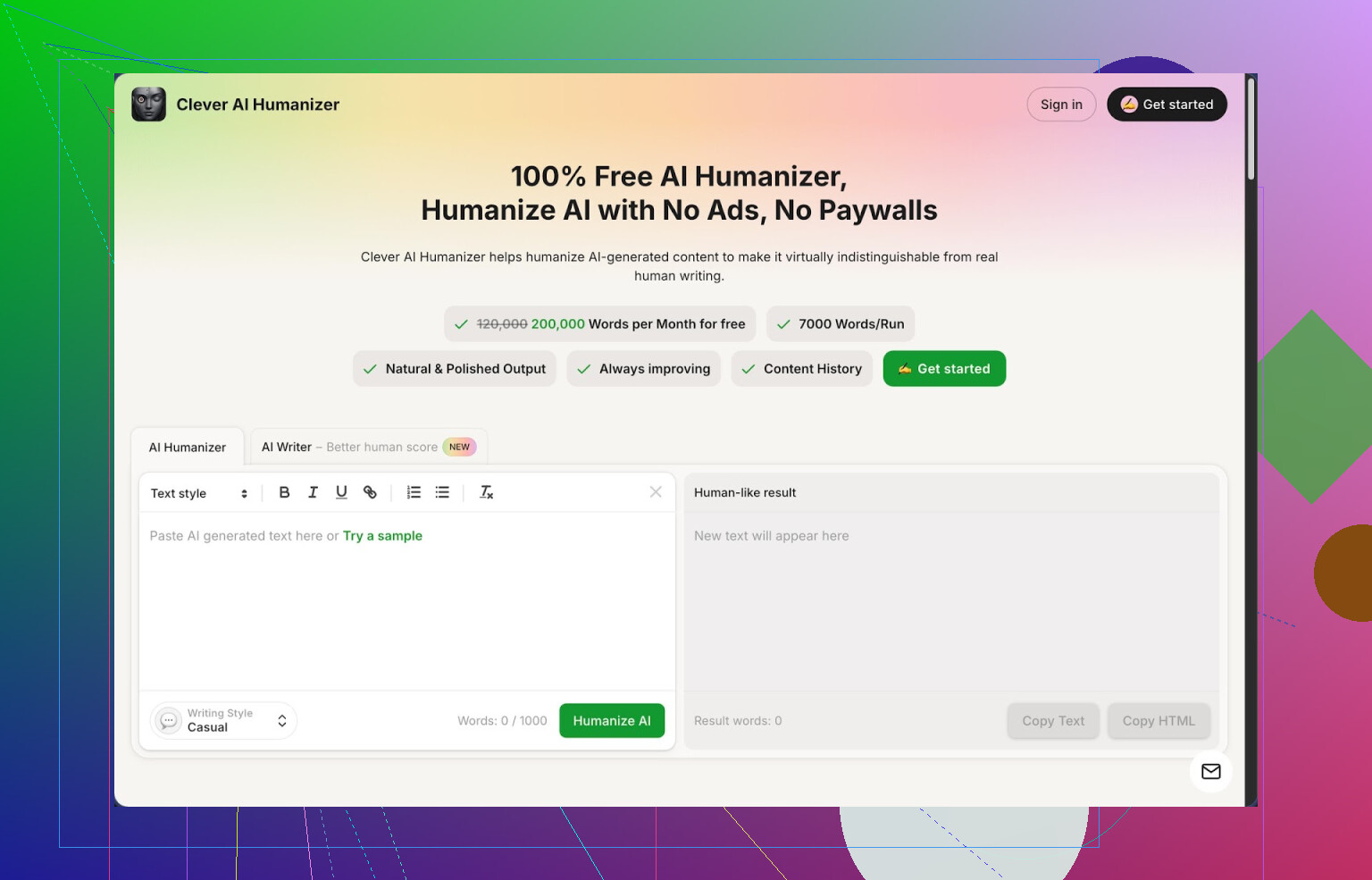
I stumbled into Clever AI Humanizer here:
https://cleverhumanizer.ai
Been using it on and off for a while, mostly for long-form stuff that kept getting nuked by detectors at work and in school portals.
Here is the short version of what I noticed:
- Free plan gives you around 200,000 words each month
- Each run handles up to roughly 7,000 words
- Three styles: Casual, Simple Academic, Simple Formal
- There is a built-in AI writer, grammar checker, and paraphraser in the same dashboard
No account limits, no credit system, no weird token counter in your face. That part surprised me a bit.
I ran three different test texts through it with the Casual style, then checked them in ZeroGPT. All three came back at 0% AI on that checker. That does not mean every detector on the internet will agree, but it passed that specific one on my side.
How the main “Humanizer” part works
My usual workflow:
- Paste something straight from ChatGPT / Claude / Gemini.
- Pick style: I mostly stick to Casual or Simple Academic.
- Let it run, which takes a few seconds.
- Copy output, then spot edit.
The output keeps the meaning close to the original. It does not throw in random new arguments or fake references. It tends to:
- Stretch some sentences
- Shift phrasing away from obvious AI templates
- Add small connective phrases that sound closer to how people write under time pressure
One thing I noticed: the word count often goes up. A 1,000 word draft might come back as 1,200 or 1,300. That seems related to trying to break patterns that detectors latch onto. If you need strict word limits, you will have to trim after.
Why I stuck with it
Most “humanizer” tools I tried before did one of these:
- Destroy the structure so badly the text became unusable
- Swap random words with awkward synonyms
- Lock useful settings behind paywalls after a few tries
This one feels more like a rewrite with a human tone in mind rather than a thesaurus mashup. I still read through every output and fix details, but it saves me from having to rewrite the entire thing manually.
For example, I fed it a technical blog post about database indexing that came from an LLM. The original sounded flat and robotic. After humanizing in Simple Academic, it read closer to something a junior engineer would write for internal docs. Still not perfect, but good enough that I only spent about fifteen minutes editing instead of an hour.
Other tools inside the site
Once you log in, it is not only a single “humanize” box. There are a few extra modules hooked together.
-
Free AI Writer
You type a topic, some brief instructions, and it generates an article or essay. The nice part is that you can run the humanizer on that output immediately inside the same flow.
When I used that combo for a 1,500 word guide, the detection score dropped compared to running an external LLM then pasting into the humanizer. Hard to say why, but the integration flow gave slightly safer outputs for me. -
Free Grammar Checker
I used this like a last pass. It fixes:
- Typos
- Punctuation
- Basic clarity issues
It is not as strict as something like Grammarly, but enough to catch random errors introduced after editing or trimming the humanized text.
- Free Paraphraser
This one rewrites existing text while keeping the same idea.
I used it on old drafts where the content was fine but the wording sounded stiff. It helped for:
- Refreshing SEO articles without rewriting from zero
- Adjusting tone from “over-formal” to more neutral or simple
- Cleaning up weird sentence structures from non-native English writers
The paraphraser is lighter than the main humanizer. It feels more like “change how this is said, keep what is said.”
How it all fits together
The site basically stacks four tools in a single place:
- AI Humanizer
- AI Writer
- Grammar Checker
- Paraphraser
My rough flow on bigger pieces:
AI writer (optional) → Humanizer (Casual or Simple Academic) → Grammar Checker → Manual trim for length
That workflow is fast if you have to push content often and do not want to juggle three or four websites.
What is not great
It is not magic. Some drawbacks:
- Some detectors still flag parts of the text as AI. You should test your own use case with your own detectors.
- Text usually gets longer, which is annoying for strict assignment or form limits.
- You still need to read what it spits out. It sometimes chooses wording that feels slightly off for specific niches, like dense legal writing or highly technical medical stuff.
For a zero-cost tool with high word limits, I accept those issues. If your situation is very sensitive, you should not rely on any tool as a full shield. You treat it more like a helper to reduce obvious AI patterns, then you layer your own edits on top.
Extra links and deeper reviews
If you want a detailed breakdown along with screenshots and detection tests, there is a longer review here:
https://cleverhumanizer.ai/community/t/clever-ai-humanizer-review-with-ai-detection-proof/42
Video review here, if you prefer watching instead of reading:
There is also some chatter about AI humanizers in general on Reddit:
Best AI humanizers thread:
https://www.reddit.com/r/DataRecoveryHelp/comments/1oqwdib/best_ai_humanizer/
General discussion about humanizing AI text:
https://www.reddit.com/r/DataRecoveryHelp/comments/1l7aj60/humanize_ai/
If you write a lot with AI and keep running into detection issues, Clever AI Humanizer sits in that middle spot between “fully manual rewrite” and “copy paste and hope.” It is not perfect, but for something free with those limits, it has earned a place in my toolkit.
If you want a true replacement for GPTHuman AI for content, coding, and brainstorming without paying, you will need a combo of tools, not a single one.
Here is what works well in practice.
- Core general AI for drafting and coding
Use the free tiers of:
• ChatGPT free
Good for quick drafts, outlines, and simple code. No cost, but rate limited.
Use it for: brainstorming, first draft of blog posts, explaining code, small scripts.
• Claude free
Stronger on long context and more “thoughtful” answers.
Use it for: long-form content planning, refactoring code, step by step problem solving.
• Gemini free
Decent for coding and technical Q&A.
Use it for: small utilities, language specific questions, comparing libraries.
You rotate between these when one hits limits. That gets close to a paid assistant without a subscription.
- Human-sounding text and editing
Here I partly disagree with @mikeappsreviewer. I would not rely on Clever Ai Humanizer only as a “detector shield”. Detectors are noisy and inconsistent. You get more value if you use it as a style and clarity tool.
Clever Ai Humanizer works well for:
• Turning stiff AI output into more natural text.
• Switching tone between casual, simple academic, and simple formal.
• Cleaning essays or blog posts from other models.
Practical flow:
Draft in ChatGPT or Claude → paste into Clever Ai Humanizer → pick style → run → quick manual edit for your own voice.
If you want less inflation in word count, start with shorter, tighter drafts, then humanize. That trims the bloat a bit.
- Coding helper setup
Use:
• ChatGPT free or Claude free for code explanation.
• Pair it with your IDE.
Example:
• VS Code + GitHub Copilot free trial sometimes + ChatGPT in the browser.
Describe the bug or function in ChatGPT.
Paste the answer into your editor.
Run and test locally.
Do not trust any code blindly. Always run tests or at least small samples.
- Brainstorming and structure
For topic ideation:
• ChatGPT: “Give 20 content ideas about X for beginners, intermediate, advanced.”
• Claude: “Group these ideas into a 4 week content plan.”
Then feed your selected idea into Clever Ai Humanizer to adjust tone.
- Strictly no cost plan
If your budget is zero and must stay zero.
Priority stack:
• ChatGPT free for 60 to 70 percent of work.
• Claude free for more complex thinking and longer content.
• Clever Ai Humanizer for style, human tone, and detection risk reduction.
• A free grammar checker inside Clever Ai Humanizer or something like LanguageTool for last pass.
You lose some convenience compared to a single paid tool like GPTHuman AI, but with this mix you cover:
• Content drafting
• Coding help
• Brainstorming
• Style fixing and humanizing
Takes a few extra clicks, saves the subscription.
Short version: there isn’t a single “GPTHuman AI but free forever” clone, but you can get 90–95% of the same power by stitching a few tools together and being smart about where each one shines.
I’ll push back a bit on both @mikeappsreviewer and @stellacadente: they’re right about mixing tools and about Clever Ai Humanizer being useful, but if you just copy their exact flow you’ll end up juggling sites way more than you need and wasting time.
Here’s what’s actually practical if you want no-cost and minimal friction:
1. One primary general model, not three
Instead of bouncing between ChatGPT, Claude, and Gemini for every little thing:
- Pick one as your main “workhorse”:
- ChatGPT free if you like snappy answers and quick code fixes.
- Claude free if you do long-form reasoning, long essays, or complex refactors.
- Only switch to another when:
- Your main one rate-limits you.
- It clearly screws up a specific task (e.g., keeps hallucinating a library).
That keeps your workflow closer to the single-tool feeling you had with GPTHuman AI instead of turning your browser into a model circus.
Use that one model for:
- First drafts of articles, essays, and outlines
- Brainstorming angles, titles, hooks
- Coding help: “explain this bug,” “refactor this,” “write unit tests for X”
2. Clever Ai Humanizer, but not just as a “detector cheat”
Both of them already covered that Clever Ai Humanizer has:
- AI Humanizer
- Built-in AI writer
- Grammar checker
- Paraphraser
Where I disagree a bit: treating it mostly as an “AI detector shield” is kind of a trap. Detectors are inconsistent, and if you chase “0% AI” scores too hard, you’ll waste more time than you save.
Use Clever Ai Humanizer for:
-
Tone and voice
Take your draft from ChatGPT/Claude and:- Run it in Casual for blog posts, newsletters, social stuff.
- Run it in Simple Academic for school work, reports, or more serious pieces.
- Run it in Simple Formal for work emails, proposals, docs.
-
Cleaning up that “robot-but-maybe-human” vibe
GPTHuman AI probably gave you passable drafts. Clever Ai Humanizer is good for making them read like someone actually wrote them under time pressure, not like a polished marketing bot. -
Bulk text passes for cheap
The free monthly word limit is big enough that you can humanize whole essays, article batches, and docs without babysitting a credit counter. That’s where it really wins for a no-cost setup.
One tip:
If your word counts keep exploding like @mikeappsreviewer mentioned, start with a shorter, tighter initial draft. Let the Humanizer add some connective tissue instead of feeding it a fully bloated essay and watching it turn into a novel.
3. Coding help: don’t overcomplicate it
You don’t need three models plus five plugins for coding.
Simple, free stack:
-
Core model (ChatGPT or Claude free)
- “Here is my function, here is the error, what’s wrong?”
- “Write a minimal example of X in Python / JS / whatever.”
- “Refactor this into smaller functions.”
-
Your IDE + copy/paste
- Paste snippets into the model, get suggestions, paste back.
- Run tests or at least simple checks; don’t trust any model as a compiler-in-the-cloud.
If you really want a “GPTHuman AI” feel for coding, keep the model page open side by side with your editor and use it like a chatty junior dev, not as a full autopilot.
4. Brainstorming & structure with minimal tools
Instead of that multi-model relay race:
-
Use your main model for:
- “List 20 content ideas about X for beginners / intermediate / advanced.”
- “Turn these ideas into a 4‑week content plan.”
- “Give me 3 different outlines for this article / video / post.”
-
Then pass the draft, not the outline, into Clever Ai Humanizer to:
- Adjust tone
- Make it sound less templated
- Smooth out transitions
No need to ping‑pong between three chatbots just to outline a blog post.
5. If your budget is literally zero
A realistic, no-drama stack:
-
One free general AI as your “GPTHuman replacement”
- ChatGPT free or Claude free as your main brain
-
Clever Ai Humanizer as your:
- Style fixer
- Humanizer for detectors if you must deal with them
- Last-pass grammar & paraphrase helper
This combo covers:
- Content drafting
- Code help
- Brainstorming
- Making everything sound more like you and less like a template
You give up some convenience compared to a single paid GPTHuman AI subscription, but you won’t be nickel-and-dimed, and you won’t need five tabs and a spreadsheet just to write a blog post.
If you try this flow and something still feels off, the usual weak point is actually not the tools, it’s prompts and editing. A quick manual pass after Clever Ai Humanizer, where you add your own examples, small personal details, and opinions, is what really pushes it over the “obviously AI” line.
Short version: you can get close to GPTHuman AI for zero cost, but the “stack” everyone is suggesting is a bit heavier than it needs to be.
Where I slightly disagree with @stellacadente / @sterrenkijker / @mikeappsreviewer
They’re right that multiple tools help, but if you’re already annoyed about paying, you’ll probably get annoyed about juggling five tabs too. I’d flip the priorities:
- Pick one main model (ChatGPT free or Claude free) and live there 80% of the time.
- Use Clever Ai Humanizer as a specialized finisher, not a second brain.
- Only bring in extra tools when you hit a hard wall like rate limits or super niche coding issues.
How I’d actually replace GPTHuman AI in practice
1. Core work: drafting & coding
- Use a single free LLM for:
- Blog/essay first drafts
- Coding explanations, debug help, refactors
- Brainstorm lists & outlines
You only hop to a second model if:
- Rate limited, or
- You can clearly see it’s confused about a specific library / framework.
That keeps your setup feeling like “one assistant” rather than a patchwork.
2. Clever Ai Humanizer as your “finishing pass”
This is where I align with the others, but with a twist: treat it like an editor, not a magic AI disguise.
Pros of Clever Ai Humanizer
- Very generous free word limits for long content.
- Good at shifting tone to casual / simple academic / simple formal without breaking structure.
- Makes stiff AI prose feel closer to rushed human writing.
- Built‑in grammar checker + paraphraser so you do not need separate sites.
Cons of Clever Ai Humanizer
- Tends to inflate word count, which is annoying for strict assignments or character limits.
- Still needs a human read‑through; niche jargon can come out slightly off.
- No tool can guarantee “detector proof” text, so you cannot treat it as a shield.
- Interface encourages full‑piece rewrites; sometimes you might want more granular control on just a paragraph.
Practical way to use it
- Draft content or code explanations with your main model.
- Paste into Clever Ai Humanizer only when:
- You plan to publish or submit it.
- You care about tone and readability.
- Run the humanizer, then do a short manual pass to:
- Add your own examples and opinions.
- Trim extra fluff if word count exploded.
That last manual pass is where you get beyond what any model / humanizer stack can do alone.
3. Content, coding, brainstorming coverage with minimal tools
- Content drafting & brainstorming: single free LLM.
- Coding help: same model for explanations, plus your editor for testing.
- Tone, flow, clarity: Clever Ai Humanizer as your final stage.
Compared to what @stellacadente, @sterrenkijker and @mikeappsreviewer laid out, this cuts a lot of context switching but keeps their main benefit: you stay at zero cost and still cover all the jobs you were doing with GPTHuman AI.