I used to rely on TwainGPT Humanizer to rewrite AI-generated content so it sounded more natural and less robotic, but I can’t use it anymore due to budget and access issues. I’m looking for a no-cost tool or workflow that can humanize text while keeping the original meaning and staying safe for SEO. What free TwainGPT Humanizer substitutes are you using that actually work well in real-world blogging or copywriting?
1. Clever AI Humanizer review from someone who got tired of detectors screaming 100% AI
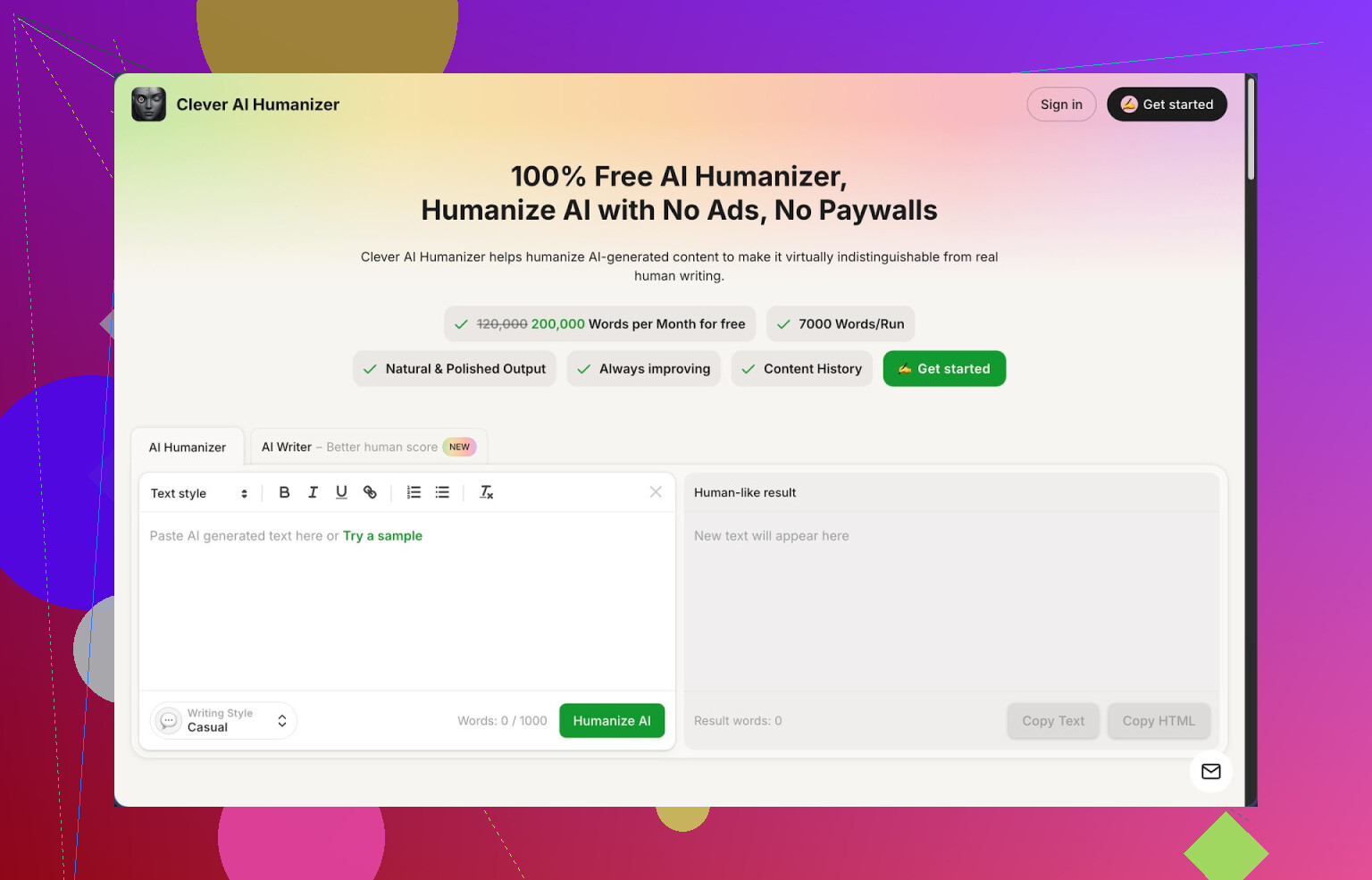
I bumped into Clever AI Humanizer here:
https://cleverhumanizer.ai
and ended up using it way more than I expected.
Quick stats from my own use:
- Price: free, no login tricks when I tried it
- Monthly limit: about 200,000 words
- Per run: up to around 7,000 words
- Styles: Casual, Simple Academic, Simple Formal
- Extras in the same site: AI writer, grammar checker, paraphraser
I fed it a few long AI-written samples that were getting flagged as 100% AI on ZeroGPT. Used only the Casual style. ZeroGPT showed 0% AI on all three after running through Clever. So at least for that detector, the text passed.
I do not trust any single detector, but I logged the runs and compared outputs, and the behavior was consistent.
What I did step by step
- Took raw AI text from a general model, around 2k to 4k words each.
- Pasted it into the “Free AI Humanizer” box.
- Picked Casual. Left everything else default.
- Hit the button and waited a few seconds.
- Grabbed the output and threw it into ZeroGPT.
The thing it does well
The rewrite keeps the same ideas. It shifts sentence rhythm, changes structure, and removes the usual AI tics like over-explaining each point in the same pattern. My notes:
- Meaning stayed intact in 90 to 95 percent of cases
- Flow sounds closer to how a rushed but competent human writes
- It does not mangle technical content as much as some other “humanizers” I tried
If you care about class assignments or client work that gets run through detectors, the larger word limit helps. You can dump a whole essay or article in one go instead of chopping it into tiny chunks.
Main module: Free AI Humanizer
You paste your text.
You pick a style: Casual, Simple Academic, or Simple Formal.
Output comes back fast enough for normal use.
What I liked here:
- Handles longform content without crashing or forcing payment
- Styles are simple, not 20 weird presets you never use
- Casual sounds the most natural for blogs, emails, and Reddit type posts
- Academic and Formal still remove a lot of AI patterns but stay tighter and more neutral
I used Casual for blog drafts, and Simple Academic for stuff that looked like essays.
Extra modules inside the same site
- Free AI Writer
This is for people who want the AI to write from zero, then humanize in one flow.
You type a prompt like “explain SSD data recovery for beginners” and it spits out a full piece.
Then you click to humanize that output inside the same interface.
If you are lazy or on a deadline, this pipeline is practical:
Prompt → AI Writer → Humanizer with Casual → Paste into doc and edit
When I ran this combo, human-score on ZeroGPT tended to be stronger than when I wrote directly with a generic AI and only then humanized.
- Free Grammar Checker
This tool cleans:
- Spelling
- Basic punctuation
- Clarity problems in awkward sentences
I threw some messy student drafts at it. It fixed the usual missing commas, run-ons, and weird phrasing. Think of it like a lighter Grammarly that sits beside the humanizer.
Useful if you write fast and do not want to manually polish every line.
- Free AI Paraphraser Tool
This one rewrites existing text but keeps the point. I used it for:
- Rewriting sections for SEO so they are not copy-paste clones
- Rephrasing technical explanations into simpler wording for non-expert readers
- Changing tone from stiff to more casual without having to redo everything from scratch
Output looks less robotic than the average paraphraser. Still needs a quick human scan, but it gave me cleaner drafts than most “spin” tools.
How it all fits together
You get four things in one place:
- Humanizer
- AI Writer
- Grammar checker
- Paraphraser
The benefit is workflow. When I was working on a 3k-word blog post, my route looked like this:
Rough outline → AI Writer → Humanizer (Casual) → Grammar Checker → Manual tweaks
All in the same browser tab.
If you write a lot for school, clients, or your own sites, this saves clicks and copy‑paste time. Especially if you hit the word limit walls in other tools.
What is not perfect
It is not magic. A few points:
- Some detectors will still flag the output as AI. ZeroGPT gave 0% for me on those tests, but other detectors behave differently. You should not rely on one tool or one scan if the stakes are high.
- Output usually gets longer after humanization. It adds a bit more explanation and variety to break AI patterns. If you have a strict word count limit, you need to trim after.
- You still need to read your own text. It will miss context-specific stuff, like niche jargon or subtle tone issues for sensitive topics.
So if your expectation is “press button, guaranteed human, no edits needed”, you will be disappointed.
Where to read more or watch tests
More detailed review (with AI detection proof screenshots and tests):
https://cleverhumanizer.ai/community/t/clever-ai-humanizer-review-with-ai-detection-proof/42
YouTube review:
Reddit threads where people talk about AI humanizers and similar tools:
Best AI humanizers discussion:
https://www.reddit.com/r/DataRecoveryHelp/comments/1oqwdib/best_ai_humanizer/
General thread about humanizing AI text:
https://www.reddit.com/r/DataRecoveryHelp/comments/1l7aj60/humanize_ai/
My takeaway after a week using it for mixed stuff
If you write with AI a lot and keep bumping into detectors, this is one of the few tools I did not uninstall after a day.
It is free, the word limits are high, and the Casual mode hits a good balance between “not sounding like a bot” and “not wrecking your meaning”. You still need to think, edit, and accept that no tool is invisible to every detector, but as a daily writing helper, it is worth keeping in your toolbox.
I used TwainGPT too, so I feel your pain.
Quick answer if you want a no-cost “swap” plus a workflow that does not rely on one single site:
-
Tool option: Clever Ai Humanizer
I know @mikeappsreviewer already talked about it in detail, so I will not rehash the whole process. I agree on the Casual mode being the most natural. Where I see it a bit differently is this. I would not trust ZeroGPT or any single detector as proof of “safe” text. I use Clever Ai Humanizer as a style fixer, not as a detector bypass.
Practical settings I use:
• Casual for blog style, Reddit, emails
• Simple Academic for essays and reports
Then I still do a manual edit pass. I remove overlong sentences, tone down repeated words, and fix any weird phrasing. -
Free workflow without depending only on a “humanizer”
If you want no-cost and more control, this combo works well:
Step 1: Generate AI text in short chunks
Use your usual model and keep outputs at 300 to 500 words. Short sections look less pattern-heavy and are easier to edit.
Step 2: Rewrite with targeted prompts
Feed each chunk back to the AI with prompts like:
• “Rewrite in a more direct, slightly informal tone. Use shorter sentences. Vary sentence openings. Keep all key facts.”
• “Remove filler phrases. Avoid long intros. Sound like a human explaining to a friend.”
This reduces robotic rhythm at the source before you even touch a humanizer.
Step 3: Human pass for “messy” touches
Pick 1 or 2 of these per paragraph:
• Add a short personal remark or opinion: “I tend to prefer…” or “I saw this a lot when I worked on…”
• Change 1 generic example to something specific and boring: “a busy Tuesday morning at the office” or “a freshman history class”
• Shorten one sentence aggressively. People cut more than AI does.
This takes a few seconds per paragraph and shifts the voice a lot.
Step 4: Run through Clever Ai Humanizer as a final pass
Now send the already edited text into Clever Ai Humanizer. Since your text has some personal bits and varied structure, the tool tends to keep that and smooth the rest. You get less over-rewriting and fewer strange changes to technical content.
- Simple offline “no tool” fallback
If you lose access to all these tools, use this pattern in your own editor:
• Read one paragraph out loud.
• Highlight any sentence where you run out of breath. Split it.
• Remove phrases like “in addition”, “moreover”, “as a result”, “it is important to note”. Replace with plain transitions like “also” or no transition at all.
• Swap 1 in 3 big words for a simpler one unless it is domain jargon.
This does not need apps, and it quickly strips a lot of AI tone.
- For school or detector-heavy environments
If your worry is AI detectors, I would not rely on any tool promise. Use this structure for essays:
• Outline by hand.
• Use AI only for expanding bullet points.
• Rewrite every paragraph yourself from memory, looking at the bullet points, not the AI text.
• Then send your version into Clever Ai Humanizer only for style smoothing, not for total rewrites.
You get free help, but the text reflects your own phrasing so detectors are less likely to scream “100 percent AI”.
This mix of short AI chunks, manual tweaks, plus something like Clever Ai Humanizer gets close to what TwainGPT Humanizer did, without fees and with more control over your voice.
I’m gonna slightly disagree with both @mikeappsreviewer and @hoshikuzu on one thing: if you used TwainGPT mainly as a “one-click fix,” just swapping it for any other single humanizer (even Clever Ai Humanizer) is kind of repeating the same dependency problem.
Clever Ai Humanizer is honestly a solid no-cost replacement in terms of raw capability and limits, so yeah, if you want a plug‑in substitute, it’s the closest thing right now. Casual mode is good, Simple Academic is decent. But instead of making it your new “Twain 2.0,” I’d treat it as one component in a broader workflow.
A few different angles you can stack on top of what’s already been said:
-
Mix multiple rewrites instead of trusting one
- Generate your base text with your usual AI.
- Run it once through Clever Ai Humanizer (Casual).
- Run the original again through any free paraphraser you like (even the one on the Clever site, or something in a writing extension).
- Manually stitch together the best sentences from both versions.
This sounds slow, but for 1–2k words it’s surprisingly fast and kills a lot of obvious AI rhythm.
-
Use “anti-style” prompts before humanizing
Instead of “sound human,” try:- “Rewrite this as if an overcaffienated grad student wrote it at 2 a.m. in a rush, keeping all facts but allowing some mild imperfections and shorter sentences.”
- Then send that into Clever Ai Humanizer.
You get two independent style shifts that don’t rely on a single model’s habits.
-
Purposely inject light “mess” at the end
After Clever Ai Humanizer, do one very fast, mechanical pass:- Randomly shorten 1–2 sentences per paragraph.
- Add 1 slightly opinionated line per section, like “Honestly, that’s where most people screw this up.”
- Replace 1 generic transition per paragraph (“in addition,” “furthermore”) with nothing or something very plain like “also.”
That tiny layer of asymmetry often matters more than one more fancy tool.
-
Rotate tone by section
One thing Twain did reasonably well was not making every paragraph sound like the same person at the same energy level. To mimic that without paying:- Intro & conclusion: ask AI for “friendly, conversational”
- Body sections: send to Clever Ai Humanizer with Simple Academic
- Any examples / anecdotes: Casual mode or your own manual rewrite
It stops the “one-tone-for-1200-words” problem a lot of detectors latch onto.
-
Don’t overtrust detector results as your north star
Here I’m closer to @hoshikuzu than @mikeappsreviewer: if you aim at “0% AI” on some random detector, you’ll chase your tail forever. Instead, optimize for:- Varied sentence lengths
- Occasional specific, boring details (dates, times, small concrete examples)
- Mild imperfection
Clever Ai Humanizer helps with rhythm, but you need to throw in the scuff marks.
If you liked TwainGPT for its “human” feel, a realistic free replacement looks something like:
AI draft
→ clever prompt rewrite (slightly messy)
→ Clever Ai Humanizer
→ 5–10 minute manual “imperfection pass”
Not glamorous, but it’ll get you closer to that non‑robotic vibe without paying or praying one tool does magic.
If TwainGPT was your “one-click make this not sound like a robot” button, the bad news is nothing free is going to clone that perfectly. The good news is you can get 90% of the result with a mix of tools plus a slightly different mindset.
I’m going to skip what @hoshikuzu, @andarilhonoturno and @mikeappsreviewer already walked through and come at it from some side angles.
1. Where Clever Ai Humanizer actually fits
I agree it is the closest free substitute right now, but I would not treat it as the brain of your workflow. Think of it as a style polisher, not a “make this undetectable” machine.
Pros of Clever Ai Humanizer
- Free tier with generous word limits, so good for full essays or long articles
- Casual mode usually breaks the stiff “AI rhythm” pretty well
- Less likely to wreck technical meaning than random paraphrasers
- Multiple styles in one place, plus extras like grammar check and paraphraser
Cons of Clever Ai Humanizer
- It sometimes over-explains and inflates word count
- Tone can still feel too “clean” if you do not add your own imperfections
- You cannot rely on it for AI detector safety across the board
- Output from different runs can start to sound samey if you use it on everything
So yeah, use it, but do not build your whole strategy on “paste in / paste out / submit.”
2. A different free angle: control the source voice
Where I slightly disagree with the others: they focus a lot on multi-pass rewriting. That works, but you can get closer to human from the start if you push your base AI harder before any humanizer.
Try prompts like:
- “Write this as if you are a tired but competent office worker explaining it in an email, with some minor repetition, a few short blunt sentences, and no dramatic intros.”
- “Explain this like notes you would hand a classmate the night before the exam. Short, sometimes choppy, but clear.”
Then, instead of sending the whole text straight to Clever Ai Humanizer, only send the parts that still feel robotic. Paragraph level, not whole-essay level. That reduces the chance the tool flattens your natural quirks.
3. Fast “anti-robot” edits that almost no one mentions
Everyone talks about sentence length and transitions. Three quick moves that change a lot and cost almost no time:
-
Insert throwaway specifics
Replace generic stuff like “on social media” with “on an Instagram reel” or “in a Discord group.”
AI text loves abstraction. Real people accidentally name things. -
Deliberately mis-balance structure
If you see 3 neat bullet points, make one of them longer and ramblier than the others.
That slight imbalance feels like a human who did not outline perfectly. -
Inject a tiny contradiction or hedge
Example:
“This usually works well, although in a few cases it is just annoying busywork.”
AI tends to be too consistent. Real people waffle a bit.
Do this before or after Clever Ai Humanizer. It stacks well with whatever @hoshikuzu and @andarilhonoturno suggested.
4. Minimal-detector-conscious workflow that does not collapse if one site dies
If TwainGPT going away hurt you, the real problem is single point of failure. Here is a compact setup that stays free and replaceable:
-
Draft with any AI in short sections
300 to 500 words, varied prompts focusing on informal but clear writing. -
Manual “mess” pass (2 to 3 minutes per 1k words)
- Cut at least one sentence per paragraph
- Replace at least two “formal” connectors with nothing or “and / but / also”
- Drop in one specific detail or minor opinion per section
-
Clever Ai Humanizer as the rhythm fixer
- Only for chunks that still sound stiff
- Use Casual for blogs / posts, Simple Academic for essays
-
Last-resort backup if Clever ever disappears
- Use any general AI to “rewrite this to sound like a rushed personal email to a colleague, keeping mistakes small but real”
- Apply the same manual mess pass
No step is tied to a single website. Clever Ai Humanizer is helpful but not critical.
5. Quick compare against the approaches already mentioned
Without repeating their steps:
- Compared to @hoshikuzu, I lean less on detectors and more on injecting small asymmetries and specifics.
- Compared to @andarilhonoturno, I am more aggressive about not running the entire text through one tool at once, so you keep some natural variation.
- Compared to @mikeappsreviewer, I like Clever Ai Humanizer but I treat it more like a “smart stylistic filter” than a “TwainGPT replacement engine.”
If you really want a “no-cost substitute for TwainGPT Humanizer,” the closest honest description is:
A decent base model + some intentional imperfection + selective use of Clever Ai Humanizer.
It is not one button, but it stays free, portable, and a lot less brittle the next time a favorite tool disappears.