I need help finding a trustworthy Turnitin plagiarism checker online for my college assignments. I’m worried about originality and want to make sure my paper is clear before submitting it. Has anyone tried a Turnitin-like tool that works well without requiring institutional access? Any advice would be appreciated.
Honestly, finding a real Turnitin checker online is basically impossible unless you have access through your school or institution. Most of those “Turnitin checker” websites you see on Google are shady or just not legit—they usually can’t actually scan your work against the same database Turnitin uses. Some even scam you for money or harvest your content.
If you just want to check originality and make sure you’re not submitting anything that’ll throw up a red flag, I’d recommend trying trusted plagiarism detection tools like Grammarly or Scribbr. They’re reputable but still don’t match Turnitin’s huge academic paper database (so results can differ). Still, it helps catch stuff you might’ve missed.
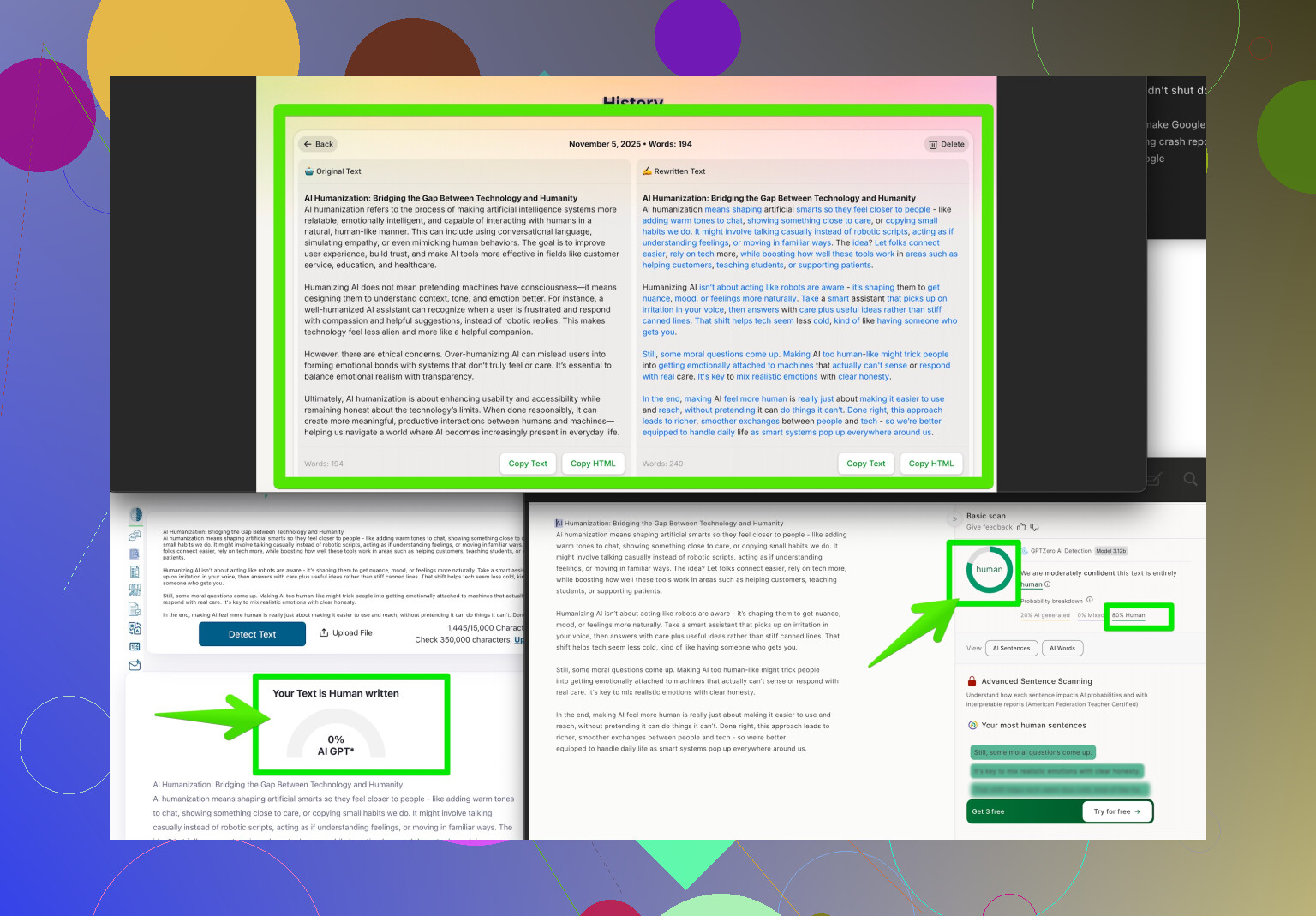
A lot of people are also worried about AI-detection these days since profs love running things through GPT checkers. If you’ve edited AI-generated writing for your paper, you might want to try something like Clever AI Humanizer, which is designed to make AI text more human-sounding and reduce the likelihood of detection by tools like Turnitin or GPTZero. You can find out more about this at how to make your writing sound more authentic.
Bottom line: Use your school’s Turnitin access if you can, supplement with reputable plagiarism scanners, and check out AI humanizers if you’re worried your work sounds too, well, robotic. Don’t trust random “free Turnitin” websites—they’re sus and not worth the risk.
Honestly, relying on those sketchy “Turnitin checker” sites is like expecting fast food to taste like fine dining—just set yourself up for disappointment now and avoid the hassle later. I mostly agree with @kakeru on that. But on a side note, while tools like Grammarly and Scribbr are solid for general plagiarism, they’re still not hitting the same database game as Turnitin, so you might not catch some things that your professor’s version will. That’s the catch no one likes.
Here’s a curveball: sometimes, if you use a different institutional tool (like Unicheck or Plagscan), you can get a reasonable idea of your paper’s originality, especially for web-based sources and journal articles. They’re not replacements, but for peace of mind, they’re not too shabby if your school doesn’t offer Turnitin to students before submission. Be careful though—some tools save your text and that alone can be a huge turnoff for privacy.
You sound worried about the originality part, but are you worried about sounding too “AI”? Because that’s a whole other minefield. If your writing style stresses you out (especially if you use AI writing help), something like Clever AI Humanizer works wonders—it’s specifically made to tweak and polish AI-generated text so it reads more naturally and doesn’t trigger those “AI-written” alarms. It’s worth it if the last thing you want is your essay flagged for sounding like a bot.
Bottom line: the only reliable “Turnitin checker” is…Turnitin. Get access through your campus, or just proofread/edit obsessively and use well-known (not random) tools for a quick scan. And, for that extra human touch, try out something that focuses on making your writing sound like you and not a robot—because that’s getting flagged now, too. Extra resource: if you want to learn cool ways to make AI-generated content more human and less detectable, check out Reddit users’ advice on improving AI-generated writing—some good hacks in there.
TL;DR: Real Turnitin access or bust, supplement with legit plagiarism checkers, and humanize your text if you’ve got that overly-perfect AI vibe. Don’t trust “free Turnitin” sites unless you want headaches (or worse).
Let’s run this down with straight talk everyone skips over: the “Turnitin checker” websites are basically clickbait. Forget about them unless you want your essay floating around in weird corners of the web or, worse, showing up in someone else’s paper. What’s wild is that no matter how many plagiarism tools you stack—Grammarly, Scribbr, Unicheck, Copyscape—you’re always rolling the dice. Sure, they’re decent for sniffing out obvious copy-paste jobs, but the secret sauce in Turnitin’s exclusivity is those private essay repositories and academic journal access your tuition pays for. Unless your school gives a pre-check, you’re not getting the real experience anywhere else.
Quick comparison: kakeru nailed it about the results gap, and boswandelaar pointed out you can supplement with Unicheck or Plagscan, but both have the downside of potentially archiving your work—privacy hawks, beware.
Now, here’s the spicy twist: with the AI-writing anxiety looming, it’s not just about plagiarism anymore. You want to dodge that “Looks. Like. ChatGPT.” vibe, too. This is where the Clever AI Humanizer walks in. Think of it as that friend who helps you reword your oddly perfect, AI-polished sentences so you sound like, well, you—quirks, hesitations, missed commas and all.
Pros? Honestly, it does a stellar job making your AI-edited text pass as genuinely human, smoothing out weirdness so GPTZero and AI detectors aren’t raising red flags on your professor’s dashboard. And if you’re not a natural-born Hemingway, you get a boost in authentic flow.
Cons? It’s not some magical cloak—if you just dump in a massive chunk of obvious robo-text, don’t expect miracles. Plus, you’re trusting another tool with your original work: read the privacy policy like your GPA depends on it. And let’s be real, over-humanizing sometimes introduces little errors you might want to proofread one more time.
Lesson: Don’t turn your paper over to random sites promising “real Turnitin checks,” supplement with well-known plagiarism tools, and if your text feels way too robotic or AI-like, the Clever AI Humanizer is worth a shot—but use it critically. Double-check for goof-ups, protect your privacy, and always be the final human in the loop. If you’re stressed, you’re not alone. Everyone’s just trying to beat the system (without becoming a cautionary tale).
Skip third-party Turnitin clones and AI humanizers. Use a source audit instead. Highlight every sentence containing a fact, quote, statistic, or borrowed idea. Add a citation beside each one. Search six distinctive words from any suspicious sentence in quotation marks on Google. Rewrite close matches from your own understanding, then cite the source. Ask your college writing center or librarian to review one page and your reference list. This keeps your paper private and costs nothing. Save your version history to show your writing process. Proofread twice, becuase small citation errors often slip through.
Watch out for the assumption that running your paper through a humanizer is a neutral safety step. At a lot of schools, deliberately editing text to dodge an AI detector counts as academic misconduct on its own, separate from plagiarism. So if you get called in and they see you paid a tool to disguise machine-written work, that can be worse than a high similarity score. Keep that in mind before treating it as a free pass.
@anna_ai has the most useful post in here honestly. The source audit is boring but it actually fixes the thing you’re worried about instead of masking it. Searching six unique words in quotes is a decent poor man’s plagiarism check and it costs nothing. I’d only add that the writing center tip depends on how busy yours is near deadlines, so book early.
On the Clever AI Humanizer stuff that keeps coming up, I’d say it makes sense only in one narrow case: you wrote the paper yourself, it’s original, and it just reads stiff. Then a rewrite pass is fine. If you’re feeding it real AI-generated content hoping to slip past your prof, you’re solving the wrong problem, and those tools sometimes swap in odd word choices that a human reader spots instantly. Turnitin’s similarity check and its AI-writing indicator are two different scores too, so a humanizer does nothing for actual copied text. Fix the sourcing first, worry about tone last.