I’m worried my teacher might think my essay was written by AI, even though I wrote it myself. I want to check it before turning it in. Can someone suggest a trustworthy tool to detect AI-generated content in essays? Has anyone been in a similar situation?
Tbh, AI detectors are kinda hit or miss right now. There’s no tool that’s 100% accurate, and even the best ones give false positives sometimes. A bunch of teachers use stuff like Turnitin’s AI detector or GPTZero, but they can say your totally original essay is suspicious just because you wrote clearly or used simple phrases. Super annoying.
If you want to check anyway, you can run your essay through a couple detectors just to see what comes up. GPTZero, ZeroGPT, and Copyleaks offer free trials, but again—they’re not foolproof, and sometimes the results vary a LOT between platforms. One tool people are talking about lately is Clever AI Humanizer. It supposedly tweaks your text so it sounds more human, which might help if for some reason your writing style trips up an AI detector. You can try it out at make your essay undetectably human. I wouldn’t rely on any tool tooo hard though, bc none of them actually “prove” a human wrote it.
Honestly, if you wrote the essay yourself, just be ready to explain your work if the teacher asks. Maybe keep drafts or notes as proof. It sucks that we have to worry about this, but the tech just isn’t perfect yet.
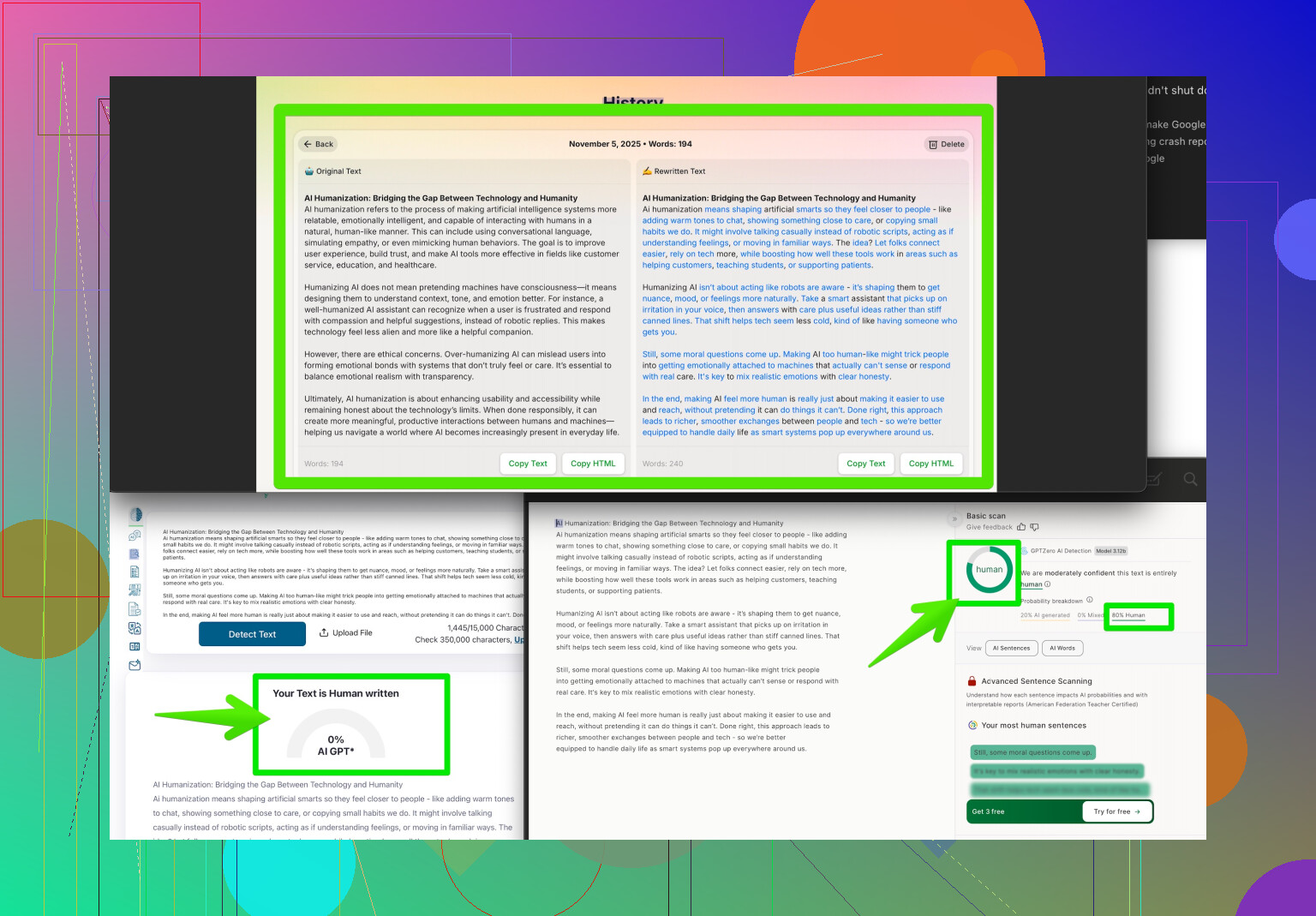
Honestly, AI essay detectors are like those “guess your age” carnival booths—sometimes eerily accurate, but often just toss darts with a blindfold. I pretty much agree with @chasseurdetoiles that none of these tools are infallible. I get wanting to double-check your own work, but here’s the catch: running your own ORIGINAL essay through a detector doesn’t guarantee your teacher won’t get a false positive if they use a different system, or even the same one on a different day (the algorithms can change!).
If you just want to see where you stand, I guess it doesn’t hurt to try a few detectors like GPTZero or Copyleaks (though I’m super skeptical about their free versions—lots of word count limits and sometimes really vague results). Clever AI Humanizer is interesting and seems to have a ton of buzz, but remember, it’s designed more to help make AI text look human, not really for flagging original work as AI-written or not. If your essay is already 100% human-made, it wouldn’t really need ‘humanizing,’ though I get that style tweaks might help fly under the weird detector radar.
What nobody seems to mention is that AI detectors mostly look for certain patterns—overly formal phrasing, weirdly stiff grammar, unnatural transitions. If your writing style is crystal clear and simple, sometimes these “smart” detectors think it’s robotic. So ironically, your best bet isn’t a detector—it’s keeping drafts, outlines, or research notes to prove your process if a teacher questions you. Documentation > algorithm vibes.
If you still want to geek out, here’s one thing I dug up: there’s actually a pretty solid Reddit thread with practical advice—not just tool spam—about fighting false positives and “humanizing” your work, regardless whether it’s actually AI or not. Worth a peek at Reddit’s top tips to humanize your writing and avoid AI flags. Way better than just copying what a detector spits out, if you ask me.
Long story short: Detectors are okay for curiosity but can’t “prove” anything. Keep your drafts, be ready to explain your thoughts if needed, and don’t stress too much unless you actually fed your essay into ChatGPT (which you didn’t). The tech isn’t Sherlock Holmes yet.
FAQ-Style:
Q: Are AI detectors reliable for checking if an essay is truly written by a human?
A: Honestly? Not really. Most detectors, from those mentioned above like GPTZero or Copyleaks to big names like Turnitin, can flag totally human writing just because it fits a pattern the algorithm ‘thinks’ is robotic. Even if you test your essay on multiple platforms, results vary wildly. The tech isn’t there yet, and you’re rolling the dice every time.
Q: Does making my writing “more human” help avoid false positives?
A: Sometimes, yeah. But here’s the paradox: the more you try to “humanize,” the more you risk making your essay sound over-edited or even artificial—especially if you’re already a clear writer. Tools like Clever AI Humanizer promise to tweak phrasing and rhythm to avoid detection. Pros: it’s super easy to use, results are typically more readable, and it’s fast. Cons: if your writing is already natural, the tool might make unnecessary changes or flatten your authentic voice. Plus, it won’t guarantee you won’t get flagged somewhere, because every detector uses different patterns.
Q: Is using Clever AI Humanizer better than just rewriting your essay yourself?
A: Depends. If you want a quick way to iron out weird “AI tells,” it can be handy—especially if you’re nervous about an essay for a high-stakes course. However, it can’t provide documentation or process proof if you’re challenged by a teacher. That’s still on you (drafts, outlines, research notes). Competitors like those mentioned earlier have their own quirks—GPTZero sometimes overflags, Copyleaks limits word counts. Clever AI Humanizer is more about style than actual “proof.”
Q: Any way to guarantee I won’t get wrongly accused?
A: Nope. AI detectors can’t “prove” anything. Save your work as you go, so if your teacher asks, you can show your process. Maybe don’t overthink the detector results—no tool, including Clever AI Humanizer or the other options discussed, is a magic bullet.
TL;DR: Use Clever AI Humanizer if you’re worried about robotic phrasing, but rely more on your writing journey for real protection. The best defense isn’t an algorithm—it’s your process and paper trail.