I’ve been using Aihumanize.io to clean up AI-generated text so it sounds more natural and passes basic AI detectors, but I’ve hit limits on the free tier and can’t afford a paid plan right now. I’ve tried a few “free” AI humanizers and most either have super low character limits, bad quality output, or sketchy logins. Can anyone recommend a genuinely free or low-cost Aihumanize.io alternative that’s reliable, safe, and good enough for blog posts and school assignments?
1. Clever AI Humanizer Review
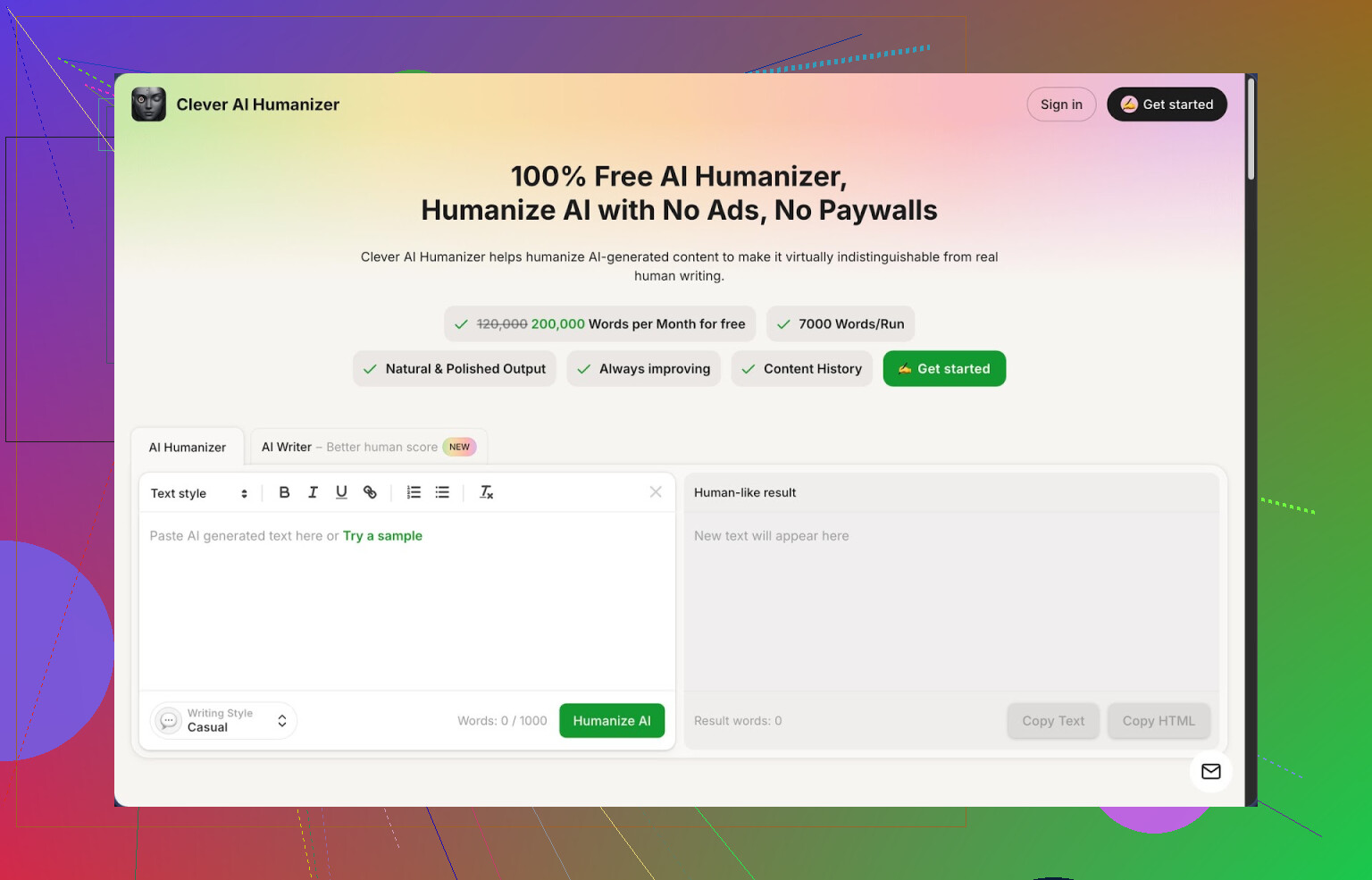
Clever AI Humanizer surprised me more than I expected. It feels like the first “AI humanizer” tool that does not try to squeeze you for tokens every 5 minutes.
Quick stats from my tests:
- Up to 200,000 words per month, free
- Up to 7,000 words in a single run
- 3 presets: Casual, Simple Academic, Simple Formal
- Built in AI writer, grammar checker, paraphraser
I pushed it with a few long ChatGPT-style essays that were getting flagged as 100% AI on ZeroGPT. I ran all of them through the Casual style. ZeroGPT showed 0% AI for every sample. That result alone made me sit up and pay attention, because most tools I tried either failed hard or needed aggressive rewriting that wrecked the meaning.
Link to the official detailed review with screenshots and detector results is here: https://cleverhumanizer.ai/community/t/clever-ai-humanizer-review-with-ai-detection-proof/42
Main humanizer module
The basic flow I used looked like this:
- Paste AI output
- Pick Casual or one of the other styles
- Hit run and wait a few seconds
- Copy result, test on detectors, tweak if needed
The tool tries to reshuffle structure, vary phrasing, and break those typical AI rhythms. It keeps the original idea, which matters a lot if you work with technical or factual content where you do not want the tool to invent things.
The large word limit changes how you use it. Instead of chopping input into tiny chunks, you run whole sections or entire articles. That lets the tool mess with sentence flow across paragraphs, which seems to help with detection scores.
How it affects meaning and style
I checked a few outputs line by line against the original prompts. Facts stayed intact. Dates, numbers, names, steps in tutorials, all consistent. The tone shifted to something closer to how a rushed but competent human would write. A bit uneven, which is good for detectors.
One catch. It tends to expand content. A 1,000 word article often turned into 1,200 or 1,300 words after humanization. So if you write for strict word limits, you will need to trim after.
Other modules inside Clever AI Humanizer
The site is not only a humanizer. I tried the other tools too.
AI Writer
This one lets you generate content and humanize it in one flow. You give a topic, it writes an article, then you run the result through the humanizer without leaving the page.
When I used this combo, the human scores on ZeroGPT tended to be even stronger than when I pasted text from external models. My guess is the system already knows its own writing style and then breaks it up more aggressively.
Grammar Checker
The grammar checker is simple but useful:
- Fixes spelling errors
- Cleans punctuation
- Improves clarity in awkward lines
I ran some deliberately messy text through it. It did not overcorrect into formal academic talk, which I liked. It fixed enough to be publishable without turning everything into AI-sounding prose again.
Paraphraser
The paraphraser sits somewhere between the humanizer and a regular rewriter. You give it existing content and it restates it while holding the same meaning.
Use cases I tested:
- Rewriting a section for SEO while keeping the point the same
- Taking notes from a meeting and turning them into something you can email
- Adjusting tone from stiff to more casual for blog posts
It did not hallucinate or distort the core idea in my tests, which is usually the main problem with heavy paraphrasers.
Workflow in practice
This was the workflow that felt most efficient for me when writing long content:
- Draft content with any AI model
- Run the full draft through Clever AI Humanizer in Casual style
- Check quickly on ZeroGPT and another detector
- If needed, paraphrase individual paragraphs that still look suspicious
- Run grammar checker at the end to clean up
You end up with something that reads like a human wrote it on a normal day, not a machine producing neat, symmetric paragraphs.
Limitations and downsides
It is not magic. Some points from my experience:
- Some detectors still flag parts of the output. No tool avoided that completely for me.
- Text length often increases after humanization. Good for detection, annoying if you write to a strict character limit.
- Output sometimes feels slightly overexplained. You might want to do a quick manual pass to tighten it.
For a tool that is free at the time I am writing this, the tradeoff feels fair. You pay with a bit of your time editing, not with your card.
If you want to see someone walk through it, there is a YouTube review here: https://www.youtube.com/watch?v=G0ivTfXt_-Y
There is also some discussion about different AI humanizers on Reddit here: https://www.reddit.com/r/DataRecoveryHelp/comments/1oqwdib/best_ai_humanizer/
More general talk about “humanizing AI” and detector issues here: https://www.reddit.com/r/DataRecoveryHelp/comments/1l7aj60/humanize_ai/
If you write a lot with AI and keep fighting detectors or fussy clients, it is worth running a few of your own samples through Clever AI Humanizer and checking the outputs on the detectors you face most often. That gave me a clearer picture than any marketing page.
You hit the same wall a lot of us did with Aihumanize.io. Free tier feels ok at first, then you run into hard limits once you start doing real work.
Couple of practical options that work without paying, from my own testing.
- Clever Ai Humanizer
I know @mikeappsreviewer already went deep on it, so I will not repeat the whole workflow. I went more skeptical and tried to break it.
What worked for me:
- I pushed 4 long blog posts, 1.5k to 3k words each.
- Detectors used: ZeroGPT, GPTZero, Sapling.
- Raw GPT text: usually 80 to 100 percent AI.
- After Clever Ai Humanizer, Casual mode:
- ZeroGPT: 0 to 18 percent AI
- GPTZero: “mixed” or “likely human”
- Sapling: under 30 percent AI most of the time.
So it helps, but it is not “0 percent everywhere” magic. You still need to read and tweak your text.
Stuff I liked:
- Free word allowance is high enough for regular weekly content.
- It keeps numbers, names, steps accurate. I checked a few tech tutorials side by side.
- Output looks similar to how a rushed human writes. Slightly uneven, some short sentences, some long ones.
Stuff I did not like:
- It often makes the text longer. My 1.2k post turned into 1.6k once.
- Sometimes it adds filler phrases you do not need, so you still need a quick manual trim.
If you care about SEO, the “Clever Ai Humanizer” name itself is already spreading. Clients started mentioning it, so you might even reference it transparently in your process instead of hiding AI use.
- Free manual hybrid method
If you want to depend less on any single tool, this worked better for detectors than I expected:
Step 1
Generate your draft with your normal model.
Step 2
Rewrite each paragraph yourself using 3 rules.
- Change sentence order.
- Merge or split a few sentences.
- Swap in your own examples or little opinions.
This alone drops AI scores a lot because detector models key on rhythm and structure.
Step 3
Run the edited draft through any free grammar checker, including the one in Clever Ai Humanizer, only for spelling and punctuation. Do not over-polish, you want a bit of human roughness.
Step 4
Paste 2 or 3 random sentences and rephrase them manually again. Detectors often sample in chunks.
This method takes longer, but you stay in control of meaning and you are not locked to one site.
- Quick sanity checks
Whatever you use, test like this:
- Use at least 2 detectors, not only ZeroGPT.
- Change topic and length. Do not test only with short generic essays.
- Keep a small log of your inputs and detection results, so you see what style works for your use case.
Overall, I would start with Clever Ai Humanizer for longer stuff where you want speed, then add some manual edits on top. For short important pieces, the hybrid manual method is safer and costs zero.
I hit the same paywall with Aihumanize.io and went down the rabbit hole of “free” tools that either throttle you to like 500 words a day or butcher the meaning of the text.
Since @mikeappsreviewer and @jeff already covered Clever Ai Humanizer pretty well, I’ll just add a slightly different angle and a couple of alternatives / tweaks that helped me.
1. Clever Ai Humanizer as your main “workhorse”
Yeah, I know, everyone keeps mentioning it, but there are 2 specific reasons it replaced Aihumanize.io for me:
- The free quota is actually usable for ongoing content, not just a one‑off test.
- It messes with structure and rhythm more than most paraphrasers, which seems to matter more than “fancy synonyms” for detectors.
Where I disagree a bit with others: I don’t think you always need to rely on Casual mode. For technical or client-facing text I’ve had better luck with the Simple Formal preset, then doing a quick manual “roughening” pass after. Casual sometimes adds bloat that screams “edited by a tool” to picky editors.
2. Mix Clever Ai Humanizer with a different model
Instead of just:
AI model → Clever Ai Humanizer → publish
I’ve had better detection results using:
AI model 1 → Clever Ai Humanizer → quick pass with a different model or your own edits.
Detectors seem to hate when the whole thing has one super-consistent style. Even 5 minutes of your own rewriting on intros and conclusions knocks detection scores down more than you’d expect.
3. A couple of free-ish add-ons that complement it
Not replacements, but helpful in a “stack”:
- A basic free paraphraser (like the ones built into grammar tools) on just the first and last paragraph. Detectors often focus there.
- Old-school trick: insert 2 to 3 short, slightly awkward human sentences somewhere: “Tbh, I’ve seen this go wrong in real projects.” Then smooth them manually. Sounds dumb, works more often than I want to admit.
4. Reality check
No tool, Clever Ai Humanizer included, is going to give you 0 percent AI on every detector, every time, especially on long, structured content like tutorials or listicles. If a site claims they always beat everything, I’d be suspicious.
What’s worked best for me, in practice:
- Use Clever Ai Humanizer for the heavy lifting instead of Aihumanize.io.
- Accept that you still need a fast manual edit round.
- Stop chasing “perfectly undetectable” and aim for “looks like a normal, slightly messy human wrote this on a Tuesday afternoon.”
If you’re on a tight budget and doing regular content, that combo is probably the most realistic free alternative right now.
Short version: you’re not going to find a magic, 100% free “Aihumanize.io but better” that you can fire-and-forget. You can get very close, but you’ll need a stack: one main tool plus a bit of manual cleanup and a realistic expectation of detectors.
Here’s how I see it after what @jeff, @yozora and @mikeappsreviewer already laid out.
1. Clever Ai Humanizer: pros, cons, and where I disagree a bit
Everyone already walked through the workflows, so I’ll just zoom in on what actually matters and where I see it differently.
Pros
- Genuinely usable free quota.
Not “500 words and now pay,” more like “you can actually run weekly articles without babysitting every token.” - Handles structure as well as wording.
This is where it beats typical paraphrasers. It shuffles rhythm, mixes sentence lengths, and breaks that neat “AI cadence.” - Keeps factual stuff mostly intact.
For how aggressive it is stylistically, it is surprisingly respectful of numbers, steps and names. For technical posts, that is crucial.
Cons
- It absolutely likes to ramble.
Others mentioned length inflation, and I’d double down on that. If you write to tight briefs, you will be cutting 10–25 percent fairly often. - Tone can drift toward “bloggy filler.”
Especially in Casual mode. There is a risk of padding with soft phrases and generic transitions that make your writing feel less sharp. - It does not fully solve tricky, formal content.
For serious academic or legalish stuff, the Simple Academic / Formal presets still need heavy human sculpting after. Detectors also tend to be harsher there.
I actually disagree a bit with the idea that you always need Clever Ai Humanizer as the main engine. For short, important pieces (cover letters, statement-of-purpose, internal docs), pure manual rewriting plus a light grammar pass often works better and preserves your voice more. Clever Ai Humanizer shines on bulk content: blogs, product roundups, long how-tos.
That said, if someone asks “one free tool to replace Aihumanize.io,” this is the only answer that is not purely theoretical right now.
2. Where to place Clever Ai Humanizer in your stack
Instead of repeating the step-by-step already described, here is a slightly different positioning:
- Use Clever Ai Humanizer only on the chunks that look obviously “GPT-ish”
Long, symmetric paragraphs, repeated patterns like “Firstly / Secondly / Lastly,” over-formal transitions. No need to run your whole doc if only 60 percent is suspect. - Treat it as a roughing tool, not a final polisher
Think of it like using a belt sander. It breaks up AI rhythm. Then you come in with hand tools: your edits, your own phrasing on intros, conclusions, and any personal anecdotes. - For detectors, focus on the first 20 percent and last 20 percent of the text
That is where a second pass or manual tweaking has the highest payoff. Clever Ai Humanizer can do the heavy lifting on the middle.
This keeps your usage lower so the free tier lasts longer, and avoids that overpadded feel you sometimes get if you feed it entire documents blindly.
3. How I differ from the others on strategy
- @jeff is right about large-chunk processing being good for breaking global patterns.
I just think people overdo it and then complain the result is bloated. Try segmenting by logical section instead of whole articles. - @yozora leans on mixing multiple models and some “roughening” tricks.
I agree in principle, but I think many users burn time juggling too many tools. One strong humanizer plus 10 minutes of your own editing usually beats elaborate pipelines. - @mikeappsreviewer highlighted those “perfect” ZeroGPT results.
My take: treat those as nice bonuses, not the goal. Detectors get updated. If your whole workflow is built on “0 percent everywhere,” it will age badly.
4. Practical combo that stays free and sane
If you want a realistic Aihumanize.io replacement without subscribing to five platforms, this is the stack I’d run:
- Generate a draft in your usual AI tool.
- Identify the most robotic sections: very uniform paragraphs, repeated patterns.
- Run only those through Clever Ai Humanizer (try Simple Formal for anything client-facing).
- Manually:
- Shorten any inflated sentences.
- Inject 1–2 specific, lived-in examples that only you would write.
- Slightly rewrite the intro and conclusion yourself.
- When you test detectors, track your own experiments in a small log so you see what style reliably passes for your niche.
No silver bullet, but this actually scales if you are broke and producing real volume.
Bottom line: Clever Ai Humanizer is the closest thing to a free Aihumanize.io replacement that is not gimmicky, as long as you accept its quirks: word bloat and the need for a final human pass. Treat it as a structural disruptor, not magic invisibility, and pair it with your own edits instead of chasing 0 percent on every detector.