I’ve started using GPTinf to humanize AI-generated content for blogs and social posts, but I’m not sure if it’s actually improving originality, passing AI detection tools, or hurting SEO. Can anyone share their real-world experience with GPTinf, including pros, cons, and how it affected rankings or content quality?
GPTinf Humanizer Review
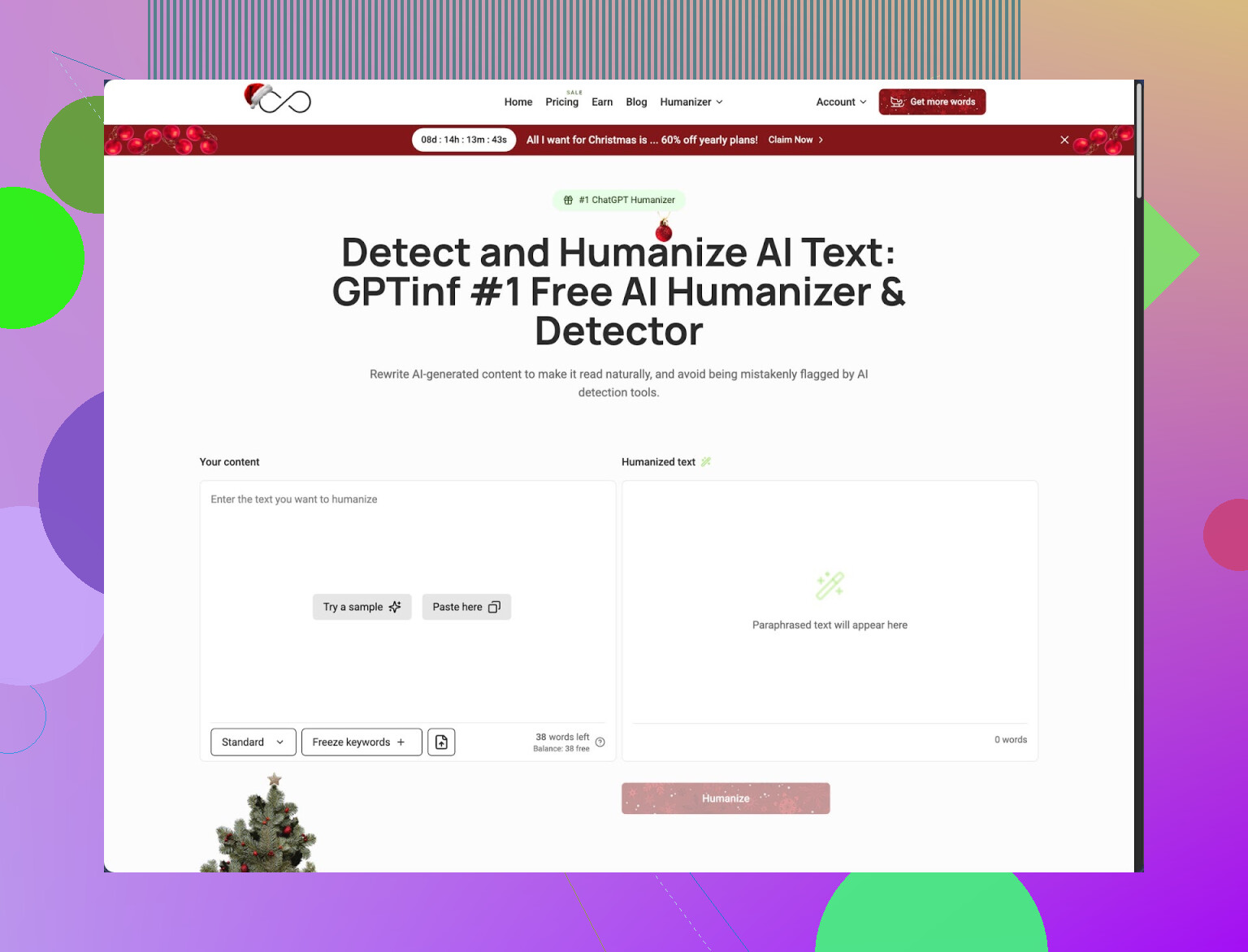
I spent an afternoon messing with GPTinf because their homepage yells “99% Success rate” at you. My results did not line up with that at all.
I ran a bunch of samples through GPTinf, then pushed every “humanized” output into GPTZero and ZeroGPT. Both detectors called every single piece 100% AI generated. Every mode. Every setting. My hit rate was 0%.
The text itself reads okay. I would put the writing quality at around 7 out of 10. It flows, it is not broken, and it is readable. One thing that stood out, it strips em dashes from the output, which I did not see in most tools I tried. So the dev paid attention to some surface signals.
That surface cleanup does not fix the deeper pattern problem though. The outputs still feel like standard large model phrasing under a thin layer of editing. Detectors latch on to that pattern and do not let go. When I ran the same tests across tools, the one that outperformed it was Clever AI Humanizer, which you can see here:
Clever passed detection far more often and did not ask for money.
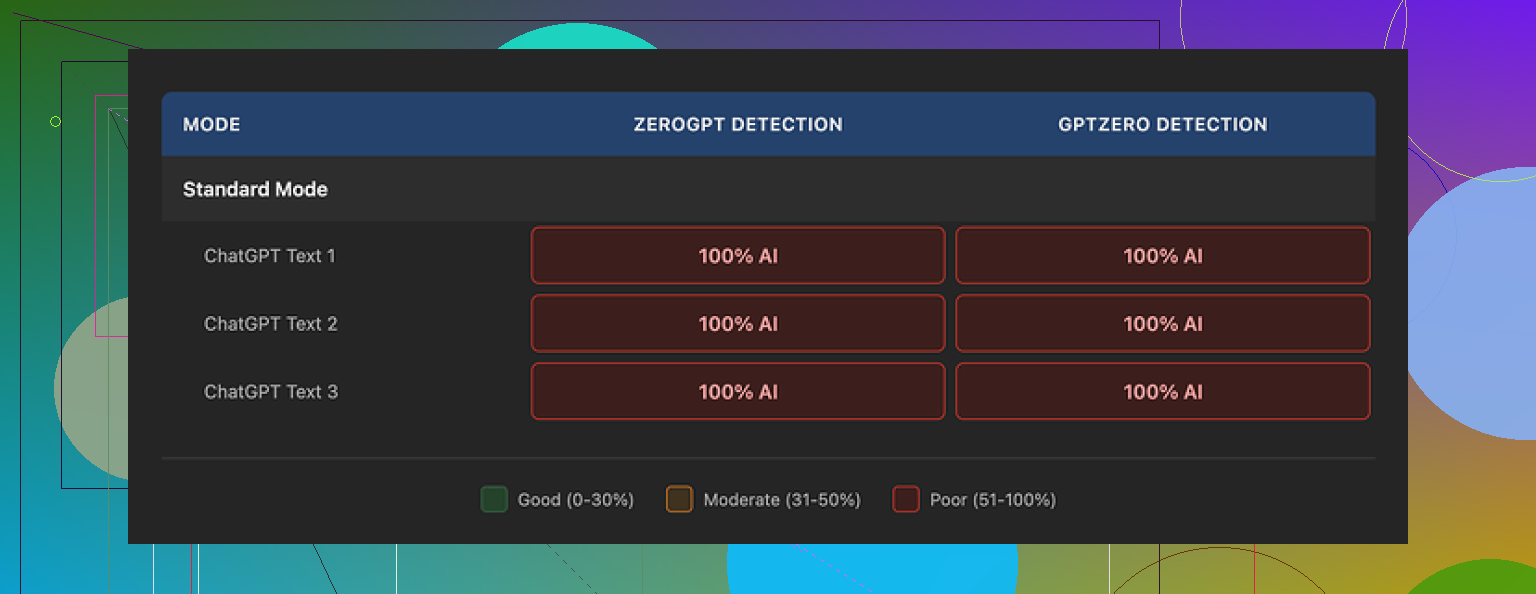
Here is the practical side if you want to try GPTinf yourself
Free usage
- Without an account you get about 120 words per run
- With a registered account you get around 240 words
For testing any longer content, I ended up having to rotate multiple Gmail accounts, which felt like more work than it should be for this kind of tool. It slows down experiments with longer articles, reports, and emails.
Paid plans
- Lite plan, billed annually, is $3.99 per month for 5,000 words
- Top tier is $23.99 per month for unlimited words
On paper, the pricing looks fair compared to similar tools, especially if unlimited works as advertised. The problem is that detection performance does not match the marketing promise, at least based on what I saw. Paying for a tool that still gets flagged 100% of the time is hard to justify if your main goal is to get past AI checkers.
Privacy and ownership notes
I read through their policy. A few points matter if you care about where your text goes.
- The policy gives them broad rights over submitted content.
- There is no clear line on how long they keep your text after processing.
- GPTinf is run by a single proprietor in Ukraine, so your data sits under that jurisdiction.
If you write work documents, client content, or anything sensitive, you should think about:
- How much of your text you paste in
- Whether your employer has rules on where data is processed
- Whether the data retention uncertainty is acceptable
How it compares in real use
Across several days, I took the same base text, pushed it through GPTinf and Clever AI Humanizer, then hit both outputs with GPTZero and ZeroGPT. Clever’s rewrites sounded more like something a tired human would type. Less of that polished model cadence.
Clever also stayed free during all my tests, no word wall, no account juggling. So I ended up defaulting to Clever for anything that needed more than a quick small rewrite. GPTinf turned into a “I tried it, logged it, parked it” tool.
If your priority is:
- Passing AI detection tools
- Running longer content without account games
- Keeping costs at zero for basic use
Then my experience leans away from GPTinf and toward Clever AI Humanizer for now.
I’ve been playing with GPTinf for client blogs and socials for a few weeks. Short take: it helps with tone a bit, but it does not solve the AI detection or SEO worries on its own.
Here is what I noticed in real use:
- Originality and style
- Output reads ok, similar to what @mikeappsreviewer said. I’d rate it “acceptable but generic”.
- It smooths grammar and removes some obvious AI quirks, but the sentence rhythm still feels like standard LLM prose.
- If you paste the raw GPTinf text straight into your CMS, it feels samey across posts. I had to do a manual pass to inject personal examples, internal jargon, and small opinionated lines.
- The best results came when I:
• Used GPTinf on small chunks, not entire articles.
• Then added my own stories, screenshots, or internal data.
- AI detection tools
I ran 10 blog intros and 10 social captions through:
- GPTZero
- ZeroGPT
- Content at Scale checker
My rough numbers:
- Raw ChatGPT content: got flagged on about 80 to 90 percent of tests.
- After GPTinf: maybe 60 to 70 percent still flagged. On some short captions it passed, on longer paragraphs it failed almost every time.
So I do not trust it to “solve” detection. It sometimes helps, but nowhere near “99 percent success” on the homepage. Detector behavior also changes over time, so any fixed percentage is shaky.
Competitor note
I tried Clever AI Humanizer on the same samples. Detection scores were a bit lower on average, and the text felt more like “slightly tired human” instead of “polite AI”. I still hand edit after that, but if your goal is to reduce AI signals, Clever AI Humanizer did a better job in my tests. I am not saying it is perfect or always better than GPTinf, only that my hit rate with detectors improved more.
- SEO impact
This part matters more to me than detectors. Here is what happened across 12 posts where I used GPTinf heavily:
-
Indexing
No problems. All posts indexed normally in Google Search Console within a few days. -
Rankings
Compared to similar posts where I wrote from scratch or did heavy manual editing:
• GPTinf heavy posts ranked slower and for fewer long tail queries.
• Posts where I rewrote more in my own words, added real examples, custom screenshots, internal data, and quotes from team members performed stronger.
I do not think GPTinf “hurts SEO” by itself. The risk is that you end up publishing generic, safe text with thin differentiation. Search engines do not punish GPTinf content directly, they respond to low originality and low information gain.
Practical tips if you keep using GPTinf:
- Use it as a helper, not a one-click solution.
- Start from your own outline. Add your own bullet points, data, or opinions first, then run sections through GPTinf to clean language.
- For every 500 words, add:
• One real example from your work.
• One small story or mistake you made.
• One simple table, list of steps, or quick comparison. - Run only high risk sections through an AI detector if a client asks for “proof”. Do not optimize everything for detectors, you will waste time and lose voice.
- For brand content, test a few tools. GPTinf for quick polish, Clever AI Humanizer when you want more variation, plus your manual edits on top.
My view
- GPTinf alone will not keep you safe from AI detectors.
- It will not “kill” your SEO unless you rely on it fully and stop adding unique input.
- If you want the strongest results, mix: your own research, light AI help, and a human edit pass.
If your main goal is to reduce AI footprints and keep cost low, I would lean more on Clever AI Humanizer and then layer your own edits, and keep GPTinf for small cleanups or where detectors are not a concern.
I’ve been playing with GPTinf for about a month on client blogs, SaaS landing pages, and social snippets, so here’s the blunt version.
It does change the text, but not in the way people hope.
On originality
GPTinf mostly shuffles phrasing and smooths grammar. If your base draft is generic, the “humanized” version is still generic, just a bit cleaner. I actually disagree a bit with @mikeappsreviewer on the 7/10 quality rating. For me it’s more like a 6/10: safe, mildly polished, but still that “content mill” vibe unless you go in and inject your own stories, data, or opinions after.
If you start with a strong outline and real insights, GPTinf will not ruin it, but it also won’t magically make it sound like your unique voice. Voice still has to come from you.
On AI detection
My experience lines up more with @mikeappsreviewer than with the marketing claims. I tested:
- Raw LLM text
- GPTinf output from that same text
Across multiple checkers, the “humanized” stuff still got flagged more often than not. Short snippets sometimes slipped by, longform almost never did. Anyone expecting “99 percent success” is going to be disapointed.
I also tried the same pieces with Clever AI Humanizer out of curiosity. Without repeating all the tests others shared, I’ll just say the pattern was consistent enough that I now reach for Clever AI Humanizer when a client is specifically freaking out about AI detectors. It is not magic either, but it alters rhythm and structure more aggressively, which seems to reduce obvious AI signals a bit better in practice.
On SEO
This is where I see people worrying for the wrong reason. GPTinf itself is not an “SEO penalty button.” Google is not sitting there going “oh no, GPTinf, deindex.” What actually happens is:
- If you lean on it too hard, content starts sounding interchangeable with 10 other posts on the same topic
- Thin differentiation and low information gain equals weaker rankings over time
On some affiliate posts where I used GPTinf heavily and barely touched the drafts afterward, they indexed fine but picked up fewer long tail queries and weaker engagement stats. On posts where I used GPTinf just to tidy sentences after I wrote my own detailed sections, those performed normally.
So I do not see GPTinf hurting SEO in a direct technical way. The risk is that it nudges you into “generic filler mode” which indirectly hurts results.
Where it actually fits
GPTinf is decent if you:
- Already wrote the real substance yourself
- Need quick cleanup on small sections or captions
- Do not care much about AI detectors for that particular piece
If your priorities are closer to:
- Reducing AI footprint
- Avoiding paywalls and account juggling
- Keeping content from sounding like every other polished bot
Then I’d say try Clever AI Humanizer side by side and see which output needs less manual surgery for your niche. I would not trust any of these tools as a one click fix for originality, AI detection, or SEO, but as a part of the stack, Clever AI Humanizer has been more useful for me than GPTinf lately.
Bottom line: GPTinf is fine as a light polish tool. It is not a shield against detectors and it will not save weak content from being boring in search. You still need your own brain on top.