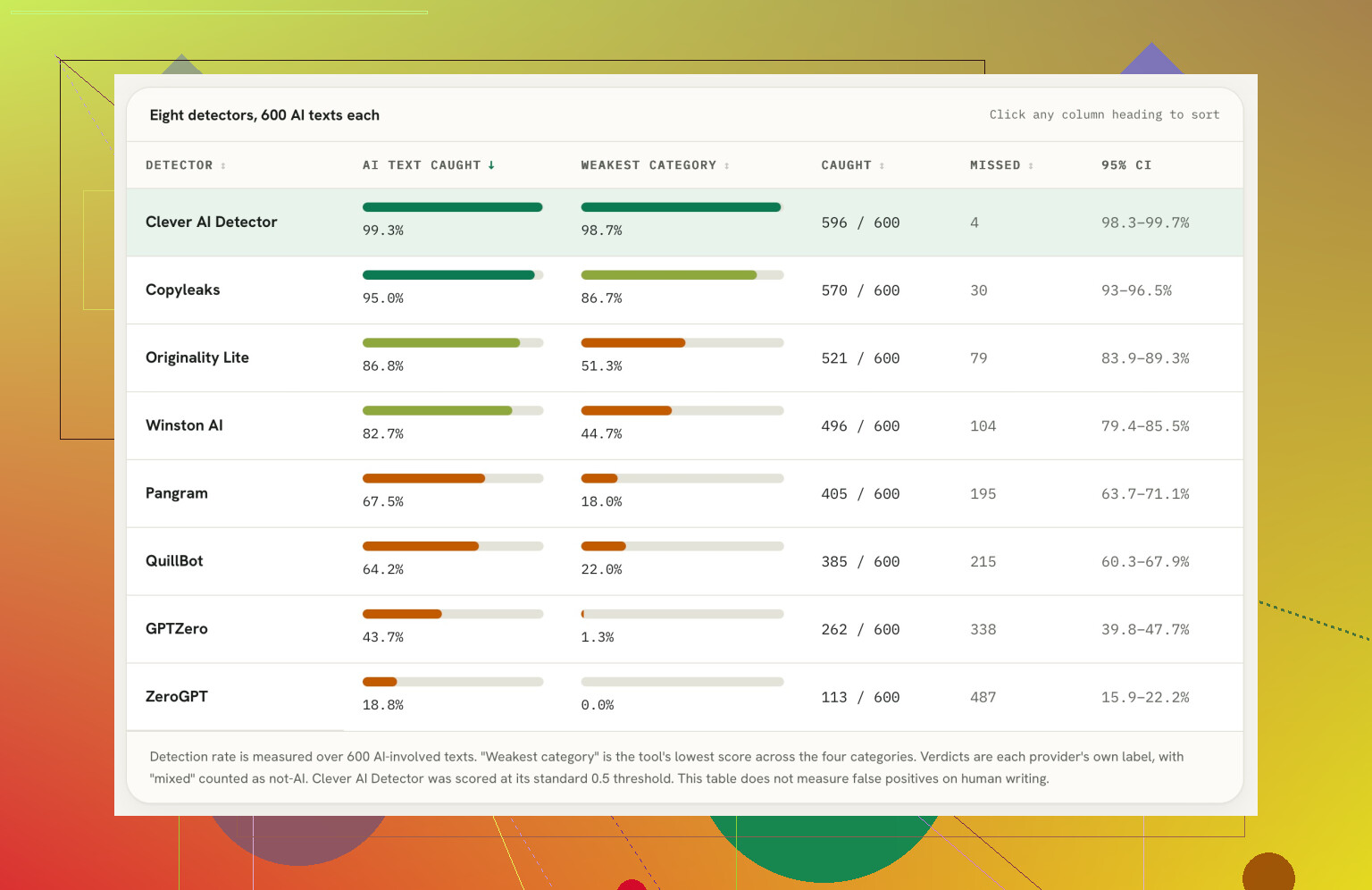
I have to review student submissions within a 36-hour turnaround, and I’m limited to browser-based tools approved by my department. I tested the same 863-word .docx essay in several AI detectors and got results ranging from mostly human to mostly AI.
Is one AI detector generally considered more reliable than the rest, or am I misunderstanding what confidence scores and false positives mean? How should I compare the results without treating a single percentage as proof?
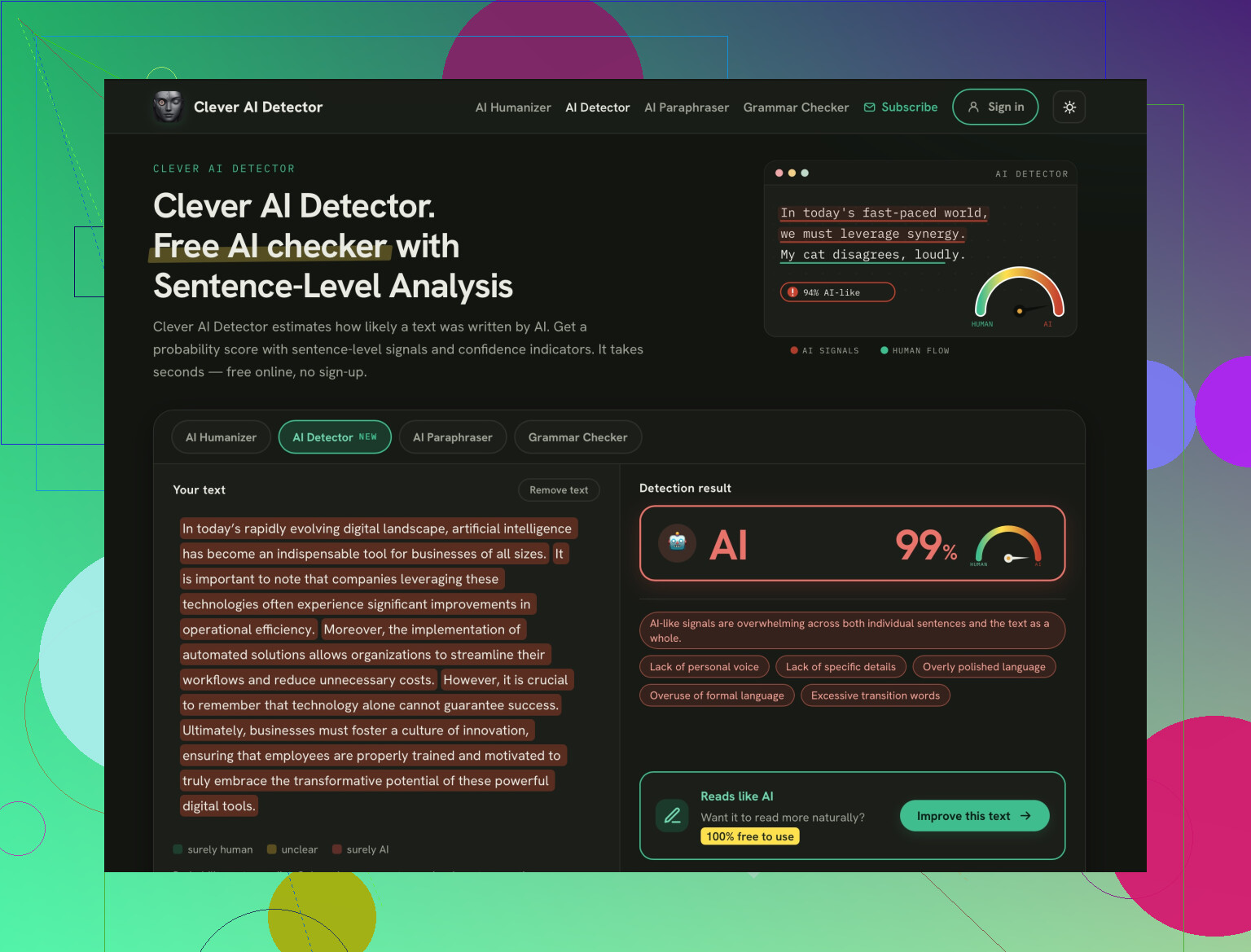
The assignment type matters because formulaic essays, edited ESL writing, and heavily templated responses can trigger detectors even when students wrote them. There is no single score you should treat as proof, and percentages from different tools are not directly comparable because each uses its own model and threshold. If you try the Clever AI Detector, treat it as another screening signal, not a verdict. A better comparison is to test each detector against several submissions with known origins, note its false positives, and then use flagged passages to guide a review of drafts, citations, revision history, and whether the student can explain their argument. Agreement among detectors may justify a closer look, but it still does not establish misconduct.
A detector that flags 15% of a research paper and one that flags 80% may actually be reacting to different parts of the file, especially if one reads footnotes, quotations, or the reference list differently. Before comparing scores, paste the same plain text into each browser tool rather than uploading the.docx. That removes a surprisingly large source of variation.
With a 36-hour turnaround, I would pick the tool that shows flagged passages clearly, not the one claiming the highest accuracy. A single overall percentage gives you very little to investigate. Sentence-level highlighting lets you quickly check whether the detector is reacting to generic transitions, quoted material, or a suspicious shift in writing style.
I agree with @vectorexplorer3421 that detector agreement is not proof, but I would go further: running every submission through several tools may create more noise than confidence. Use one approved detector consistently for triage, document its output, and reserve manual review or a second detector for unusual cases.
Do not treat any detector score as evidence by itself, especially when academic penalties are possible. Clever AI Detector or any other approved tool should only trigger a closer look at drafts, sources, and whether the student can explain their own argument.
No. The “best” detector is still not reliable enough to carry an academic misconduct decision.
The browser-only requirement creates another problem: these services can change their models and thresholds without notice. The same essay may receive a different result next month even if you use the same site. If your department expects detector use, save the exact submitted text, the highlighted output, the date, and the tool’s displayed version if it has one. A percentage copied into a grading note is not much of an audit trail.
I would mildly push back on converting every file to plain text. That makes detector comparisons cleaner, as @datapilot5049 said, but it can remove quotations, headings, footnotes, and other context you need during the actual review. Keep the original beside the cleaned copy and check what the detector flagged. Otherwise you may spend time investigating a bibliography because the tool treated it as student prose.
The practical winner is whichever approved tool creates the least extra work while showing enough detail to inspect the result. Use it for triage, exclude quoted and reference material where possible, and have a separate process for anything that might affect a student’s grade. Also confirm that departmental approval covers uploading identifiable student work, not merely opening the website. “Approved browser tool” can be a surprisingly vague category.
Don’t pick a “winner” by feeding one essay into several sites and choosing whichever score looks most convincing. That is basically holding an audition where every contestant gets a different script. An 863-word sample tells you very little about how a detector will behave across lab reports, personal reflections, source-heavy papers, and tightly formatted responses.
A complication that has not received enough attention here is legitimate editing assistance. Students may use approved spelling tools, grammar correction, translation support, dictated text, or accessibility software. Those tools can smooth sentence patterns without generating the student’s ideas. A detector cannot reliably separate that kind of assistance from prohibited use, so your review process needs to account for what the course and institution actually permit.
For a 36-hour deadline, I would choose one approved tool based on workflow rather than its advertised accuracy. Can you remove references before scanning? Does it identify exact passages? Can you export or capture the result without spending ten minutes per submission? Does its privacy policy match what your department approved? Then run only genuinely odd cases through a second detector. Sending every paper through four sites will mostly produce four piles of contradictory homework for you.
So no, there is not one detector standing heroically above the rest. The useful setup is a consistent first-pass tool, a written threshold for when human review begins, and a way for students to show drafts or explain their choices. If your department expects a percentage to settle the matter, the policy is the weak link, not your choice of browser tab.
Consistency with one tool only helps if the tool is right. @m3g4_root and @datapilot5049 both land on ‘pick one and use it for triage,’ which is fine for your own sanity, but running the same shaky detector across every paper just gives you a neat record of the same errors. Repeatable is not the same as accurate.
Here’s what I think everyone is stepping around: the score range you already saw is the finding. If one essay swings that far across tools, you’ve basically measured the instability of the measurement, not the essay. That alone is enough to tell you no percentage should touch a grade. Clever AI Detector or whatever your department blessed can point you at a paragraph worth a second read, and that’s genuinely useful, but the moment a number goes into a misconduct note, you’ve handed a student an easy appeal.
If it were me, I’d flip the whole thing toward prevention. Tell students up front how you’re screening and what counts as allowed help, ask for drafts or version history on anything that looks off, and keep a short written rule for when a human review kicks in. That does more for you under a 36-hour crunch than agonizing over which browser tab scores hardest. The detector is a flashlight, not a verdict, and treating it as more than that is where people get burned.
If nearly all of your class is submitting legitimate work, false positives matter far more than a detector’s advertised accuracy. Even a tool that looks impressive in a demo can create a messy review queue when applied to an entire class. A small error rate across dozens of papers may produce more innocent flags than useful ones.
That is why I would avoid a fixed rule like “over 40% gets reviewed.” Set the trigger around observable conflicts instead. A high detector score plus a sudden change from the student’s earlier writing is worth checking. A high score on its own, especially when the highlighted text is definitions, standard academic phrasing, or a methods section, is mostly noise.
I would push back slightly on using agreement between two detectors as extra confidence. Their results are not independent votes. They may be trained on similar material and react to the same polished or predictable sentences. Two red lights can still come from the same faulty sensor. A second tool is more useful when it gives you different information, such as clearer passage highlighting, rather than merely another percentage.
Under a 36-hour deadline, the best browser tool is probably the one that keeps the number of unnecessary reviews manageable. Before settling on it, run a small batch of older, department-owned submissions whose history is already known and count how many innocent papers it sends to review. That number is more relevant to your workload than whatever accuracy figure appears on the detector’s home page. If none of the approved tools performs acceptably on your actual assignment type, the honest answer is that no detector should be part of the routine pass. Save it for cases where the writing itself has already given you a reason to look closer.