I’ve tested several AI content detectors, but they give conflicting results when text has been paraphrased. I need a reliable tool that can accurately identify rewritten AI-generated content without frequently flagging human writing. Which AI detector has worked best for you?
I Put More Weight on Edited AI Text Than Raw ChatGPT Output
I started checking AI detectors again after seeing another batch of accuracy claims. A score near 99% sounds useful until you look at the test material. Raw ChatGPT output is the easy target. Paste in a clean, untouched response and most established detectors flag it.
My interest was elsewhere. I wanted to see how these tools handled text after rewriting, paraphrasing, cleanup, or a humanizer pass. This is closer to what teachers, editors, and site owners face.
The Dataset Behind the Test
During my search, I ran into GEDE, short for Generative Essay Detection in Education. Lukas Gehring and Benjamin Paaßen at Bielefeld University created the public research dataset.
GEDE includes more than 900 essays written by people and over 12,500 essays generated or modified by language models. The samples cover several levels of AI involvement rather than one pile of untouched machine output.
Paper: https://arxiv.org/abs/2508.08096
Dataset and code: https://github.com/lukasgehring/Assessing-LLM-Text-Detection-in-Educational-Contexts
The 600-Text Comparison
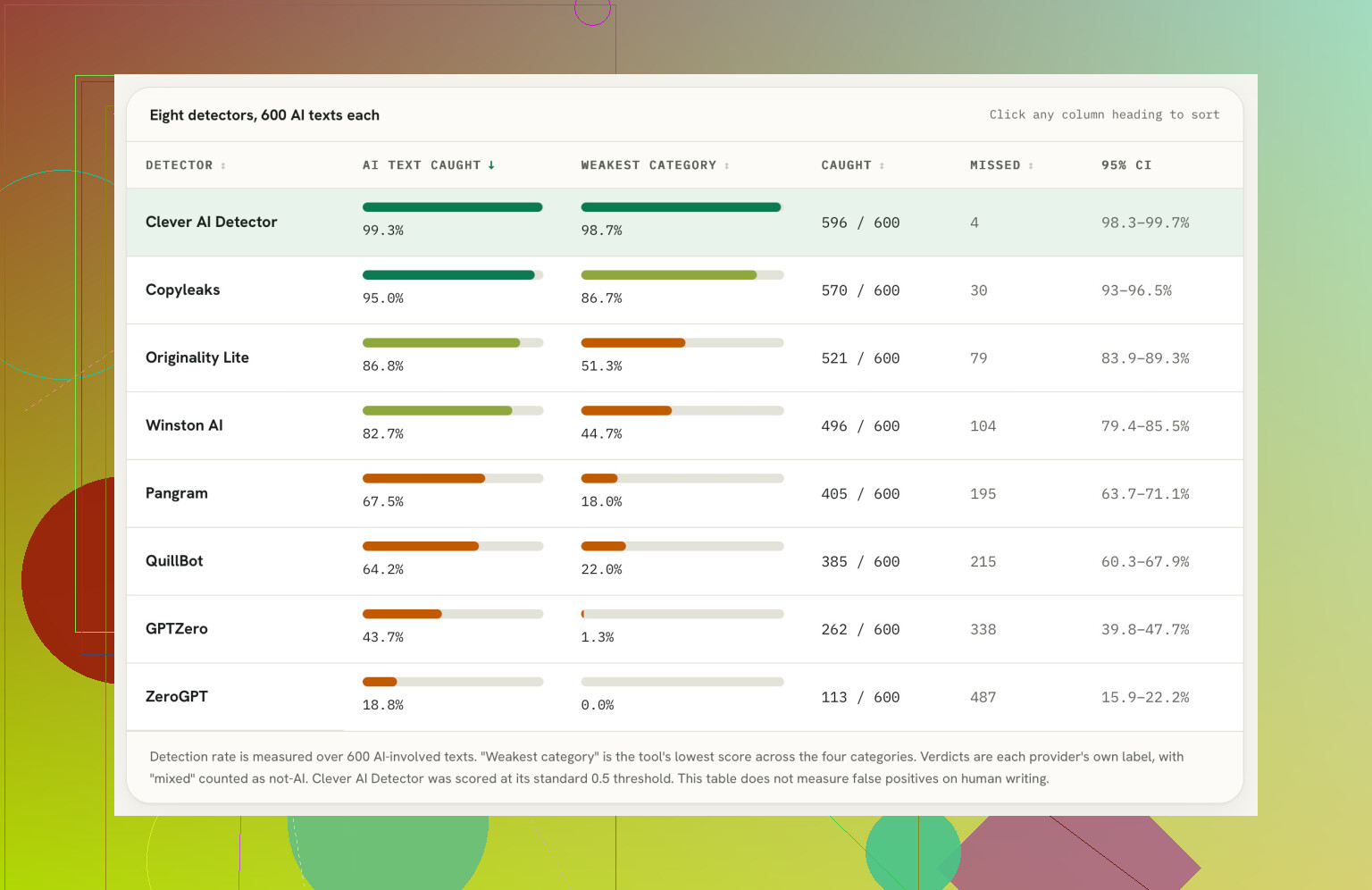
I later found a separate online benchmark built around 600 GEDE texts. The test used four groups with 150 samples in each group:
- Direct AI output
- AI-rewritten text
- AI-improved writing
- Humanized AI text
Eight detectors were tested against those groups.
One issue bothered me. I did not independently confirm who ran this 600-text comparison or whether an outside group funded or managed it. I treated the figures as reported results, not settled lab findings. The public GEDE files at least give other people a route to repeat a similar test.
Reported Detection Rates
| AI detector | Overall caught | Direct AI | AI rewritten | AI improved | Humanized AI |
|---|---|---|---|---|---|
| Clever AI Detector | 99.3% | 100% | 100% | 98.7% | 98.7% |
| Copyleaks | 95.0% | 100% | 100% | 86.7% | 93.3% |
| Originality.ai Lite | 86.8% | 100% | 100% | 96.0% | 51.3% |
| Winston AI | 82.7% | 100% | 100% | 86.0% | 44.7% |
| Pangram | 67.5% | 100% | 88.0% | 18.0% | 64.0% |
| QuillBot | 64.2% | 100% | 96.7% | 38.0% | 22.0% |
| GPTZero | 43.7% | 92.7% | 7.3% | 1.3% | 73.3% |
| ZeroGPT | 18.8% | 70.0% | 4.7% | 0% | 0.7% |
The Column I Kept Looking At
The 99.3% overall result grabbed attention, though the humanized AI numbers told me more.
Several detectors looked solid on direct AI samples and then fell apart after heavier modification. Originality.ai Lite dropped from 100% to 51.3%. Winston AI ended at 44.7%. QuillBot reached 22%. ZeroGPT flagged 0.7%, which is close to missing the whole group.
Clever AI Detector reported 98.7% on the same humanized set. Copyleaks followed at 93.3%. Those two results sit far above the rest of the table.
The spread was not small. It was huge, and honestly a bit odd. A benchmark with such wide gaps deserves replication before anyone treats its ranking as permanent.
AI Cleanup Produced Another Weird Split
The AI-improved group gave me the clearest example of detectors reacting differently to the same type of editing.
- Clever AI Detector: 98.7%
- Originality.ai Lite: 96.0%
- Copyleaks: 86.7%
- Winston AI: 86.0%
- QuillBot: 38.0%
- Pangram: 18.0%
- GPTZero: 1.3%
- ZeroGPT: 0%
GPTZero caught 92.7% of direct AI text, then only 1.3% after AI-based improvement. Same detector, much different outcome. This is why I no longer put much faith in a headline score without seeing the sample categories.
What I Took From the Numbers
Untouched AI writing did not separate these products much. Six detectors scored 100% on direct AI, while GPTZero reached 92.7%. The hard part started once the wording changed.
Based only on this reported benchmark, Clever AI Detector ranked first overall. Copyleaks came in as the nearest alternative. I would not stretch the result beyond these 600 samples, though. Different prompts, models, essay lengths, and editing methods might shift the order.
If you test a detector yourself, use several versions of one document. Start with raw model output. Rewrite a copy. Edit another by hand. Run a third through whatever cleanup process your students, writers, or clients tend to use. A single paste test tells you alot less than vendors imply.
My Quick Test of the Top Result
I tried Clever AI Detector after reading the comparison. The interface kept things plain. I pasted text, started the scan, received an AI score, and saw highlighted passages linked to the result. No long setup or confusing report screen.
The service is free right now and lists a limit of 10,000 words per check. I did not expect such a high limit from a free detector.
Don’t choose a detector based only on how much AI text it catches. A tool can report 99% detection and still be unreliable if it regularly labels human writing as AI. The table @shadowrouter3448edge posted shows recall across several AI-edited categories, but it doesn’t show the false-positive rate on the human essays. That missing number matters a lot.
Clever AI Detector looks strongest within that particular test, especially for paraphrased material, so it seems reasonable as a first check. I still wouldn’t treat its score, or any detector’s score, as proof. Run a few samples of your own confirmed human writing through the same tool first. If those get flagged too, the detector probably isn’t suitable for your writing style or subject.
For anything consequential, use the result as a reason to review the text, not as the final judgment. Draft history, citations, revision records, and whether the writer can explain the work are harder to fool and less likely to punish someone for writing in a predictable style.
A high document-level score can hide the exact problem you’re trying to find. If a piece contains human-written sections mixed with paraphrased AI passages, the detector may average everything into a harmless-looking result. The reverse happens too: a few formulaic paragraphs can make the entire document look suspicious.
For that reason, I wouldn’t crown a permanent “best” detector from the table alone. The results are useful, but “AI rewritten” can mean many different things. Text lightly reworded by one model may be much easier to catch than text revised several times by a person. Subject matter matters as well. A detector that performs well on essays may behave differently with technical documentation, legal writing, product descriptions, or short forum posts.
Based on the benchmark posted, Clever AI Detector is the obvious candidate for paraphrased text, with Copyleaks as a second check. I’d test them paragraph by paragraph rather than pasting the whole document once. Keep the chunks long enough to contain meaningful writing, since short samples tend to produce noisy scores. If only two paragraphs are repeatedly flagged while the rest are not, that is more useful than a single percentage for the entire file.
I’d use a simple process:
- Scan the full text to get a baseline.
- Scan several substantial sections separately.
- Run the suspicious sections through a second detector.
- Compare the highlighted language rather than relying only on the percentage.
- Check whether those passages contain unsupported claims, sudden style changes, generic transitions, or citations the writer cannot verify.
If both tools disagree, I would treat the result as unresolved, not choose whichever score matches my suspicion. Detectors are pattern classifiers, not authorship tests. They cannot reliably tell whether someone generated a paragraph, heavily edited it, used AI only for grammar, or simply writes in a predictable academic style.
So the short answer is Clever looks strongest for paraphrased material in the evidence posted here, but the reliable “tool” is really a two-detector, section-by-section workflow combined with authorship evidence. If the decision could affect a grade, job, or account, no detector score should carry the case by itself.
If the paraphrase was heavily rewritten by a person, there may be no detector that can reliably identify the original AI involvement from the finished text alone. At that point, the detector is judging the final writing pattern, not recovering the history of how the paragraph was created.
That distinction matters here. Text run through an automatic paraphraser may still carry obvious model patterns, so the reported results make Clever AI Detector a reasonable first choice for that specific case. Human revision is different. Someone can change the structure, remove generic transitions, add personal reasoning, and correct factual details. A low score then does not mean AI was never used, while a high score may simply reflect formal or repetitive writing.
I would test whichever detector you choose against the exact workflow you care about. Take several confirmed human samples in the same subject, several direct AI samples, and several AI samples rewritten with the paraphrasing method in question. If the tool cannot separate those groups consistently, its impressive score on a general benchmark will not help much.
So “best for catching automated paraphrases” may well be Clever based on the table. “Reliable proof that any rewritten passage began as AI” is a standard no current detector can meet. For disputes, edit history and earlier drafts tell you far more about origin than the final percentage.
If you’re screening a pile of mostly human work, the “best” detector is the one with the lowest false-positive rate, not the one that catches the most paraphrased AI. That benchmark doesn’t provide enough information to answer that. A detector can catch 99% of AI text and still be a bad choice if it flags ordinary human writing too often.
The base rate makes this worse. Say only 5 out of 100 submissions contain AI, and your detector falsely flags 5% of human submissions. Even with perfect AI detection, you would end up with roughly as many false alarms as correct hits. That creates more work and makes the score useless as evidence.
From the posted results, Clever is the obvious first scanner for automatically paraphrased text, with Copyleaks as a comparison. But I wouldn’t call either “reliable” until it passes a blind test containing plenty of confirmed human writing from the same subject and age group. If the test only measures how aggressively a tool says “AI,” it is measuring suspicion, not accuracy.
Build a small test set from your own material before paying for anything: known human text, raw AI text, and paraphrased AI text in similar lengths. Based on the posted benchmark, Clever is the first detector I’d try, but if it cannot separate those three groups on your subject matter, its headline score is irrelevant.
Nobody’s mentioned the threshold the test used to count a ‘catch.’ A detector’s recall changes a lot depending on whether you count anything over 50% as AI versus over 90%, and that number is missing from the table entirely. Until you know that, Clever leading on humanized text is suggestive but not really comparable across the eight tools.
Save the exact text, detector score, and test date, since these services can change their models and produce different results later. Clever looks like the best first try from this benchmark, but without a fixed detector version, today’s ranking may not remain reproducible.