I’m struggling to find a reliable AI humanizer in 2026 that can make AI-written content sound natural enough to pass manual reviews and AI detection tools. I’ve tested a few options, but the outputs still feel robotic or get flagged. Can anyone recommend tools, workflows, or settings that actually work today, especially for blog posts and SEO content?
Best AI Humanizers in 2026, tested the hard way
I spent a few ugly weekends running the same blocks of ChatGPT text through a bunch of “AI humanizers,” then throwing the results at GPTZero and ZeroGPT. I also checked how the writing looked to a human, how pricing works, and whether the terms sound safe to use.
Short version, most tools failed on something. Some “premium” ones looked slick and performed like a high school paraphraser. A couple surprised me in a good way.
Here is what stood out.
- Clever AI Humanizer – the only one I still use daily
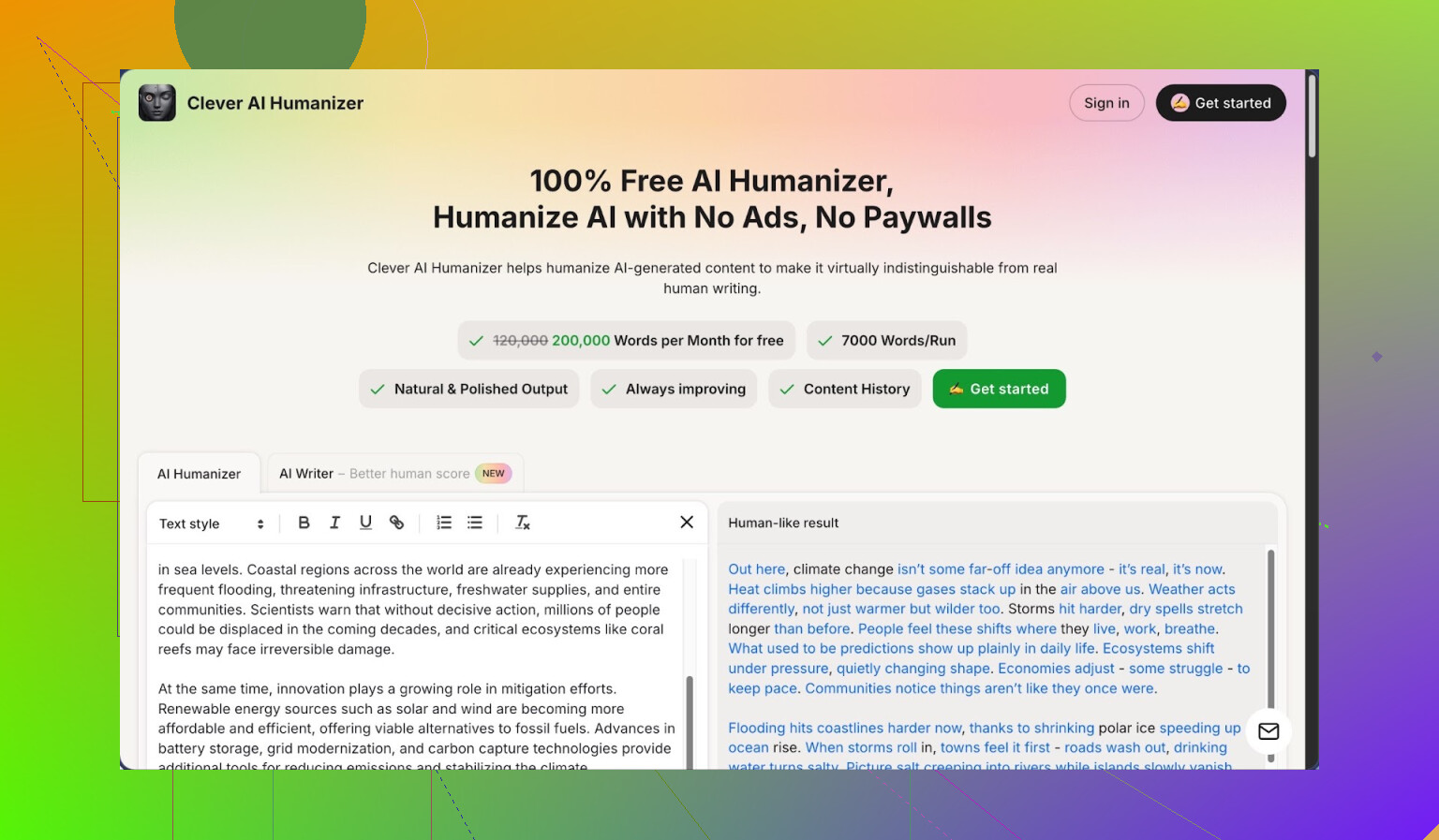
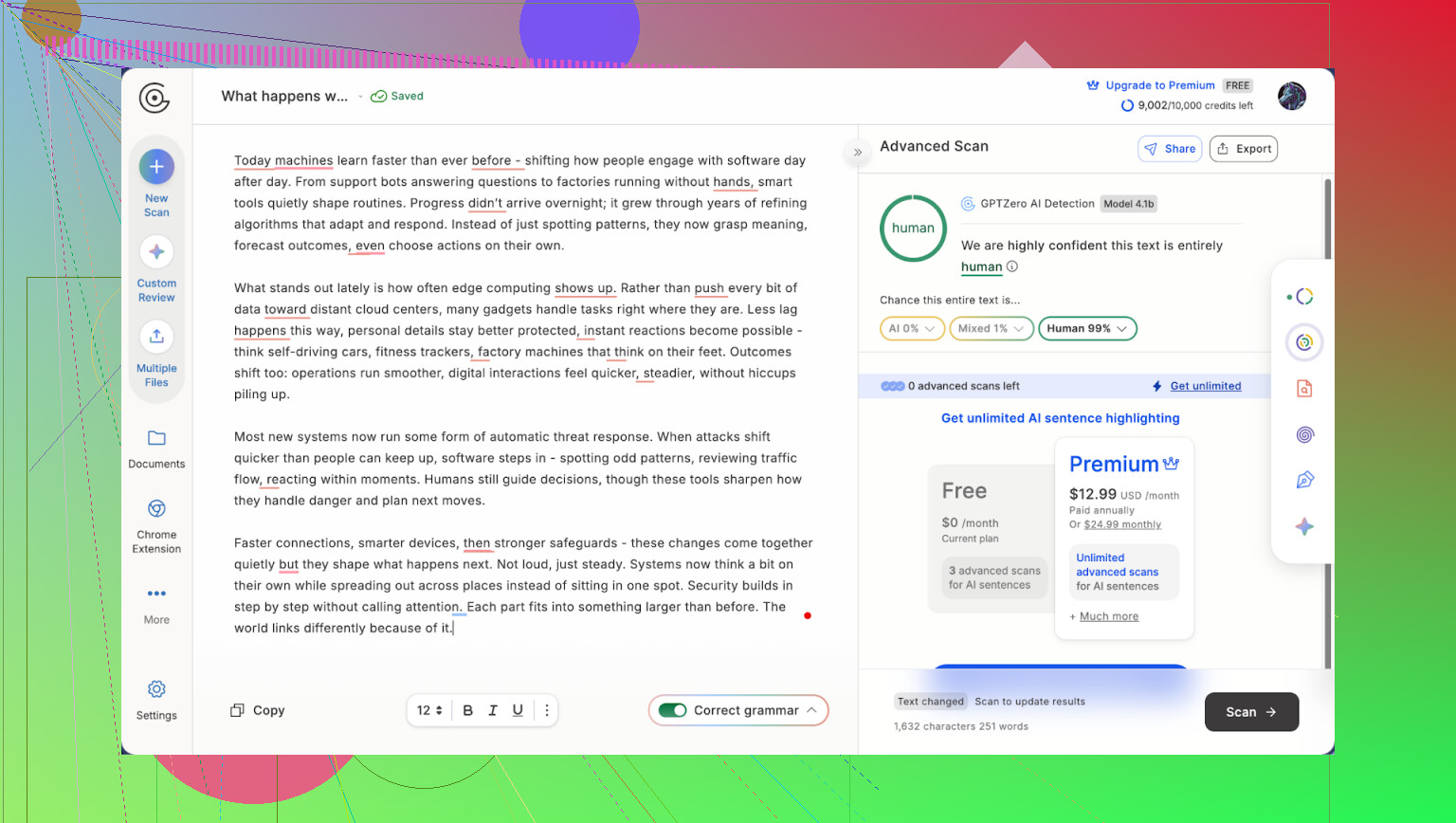
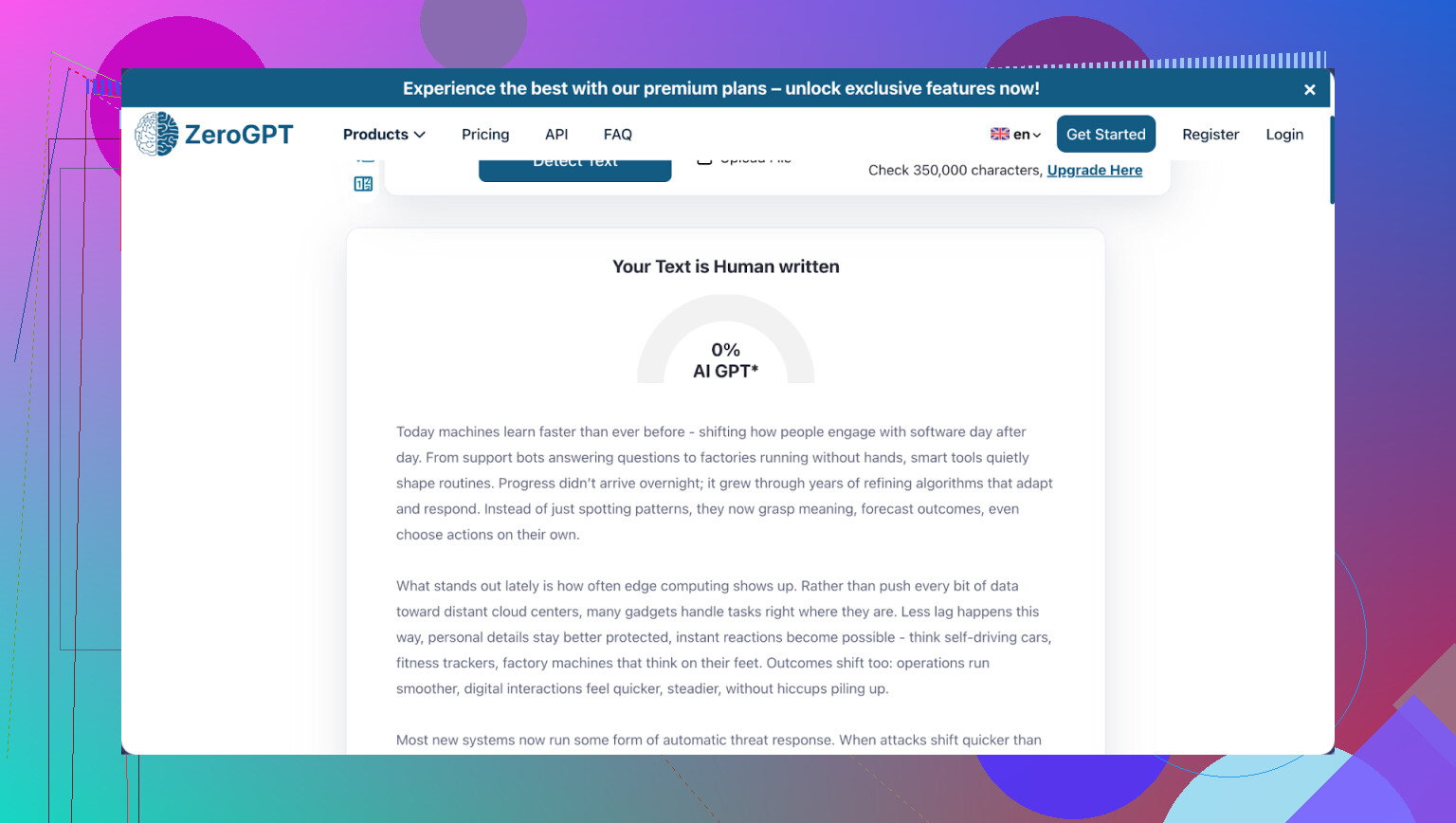
Best for: Students, bloggers, people doing client work who need a ton of “de-AI’d” text without hitting a hard paywall every 5 minutes.
My rough scores
Detection: 7 out of 10
Writing quality: 8 out of 10
Site: https://cleverhumanizer.ai/
Out of everything I tried, Clever AI Humanizer felt the most like a tool built by someone who has actually been burned by AI detectors before.
The big thing is the limit. Almost every other service locks you to something like 125 to 300 total free words then spams you with upgrade prompts. Clever gives you up to 200,000 words every month on the free tier. Per run you can push around 7,000 words through it, which is more than any other tool I hit.
No fake “lite” mode either. The free plan uses the same humanization engine, lets you see your past runs, and does not ask for a card. From what I read, it is backed by Clever Files, which has a habit of letting products run free for a while to see if they catch on.
The humanizer has four modes, and they are not cosmetic.
• Casual
Soft, chatty, and usually scores as human on ZeroGPT. This one worked well for essays and blog-style content. I did not have to rewrite much.
• Simple Academic
Keeps more formal terms but avoids those long, robotic sentences that detectors love to flag. I used it on a couple of research-style pieces and it stayed readable.
• Simple Formal
Office email tone. Clean, not stiff. It felt safe for business docs and cover letters.
• AI Writer
This one surprised me. Instead of paraphrasing, it writes from scratch and strips the usual AI patterns. I compared it against both detectors and it did much better than pasting in raw ChatGPT output.
What helped for me is that each mode changes structure and rhythm, not only words. Most humanizers I tried reshuffled phrases and called it a day. Here I often pasted the result straight into my doc.
Pros I noticed
- 200,000 free words per month, no nonsense
- 7,000 words per run, good for long essays and reports
- ZeroGPT gave clean results in all my tests
- Output looks like something an actual person might write
- Keeps a history of what you ran through it
- No card needed for the free plan
- Output quality seemed to improve week to week
- Interface is simple, no bloated dashboard
Annoyances
- GPTZero is still hit or miss with tougher prompts, though it is getting better
- No paid option, so if you need beyond 200k words per month you are stuck
Pricing: FREE
If you want outside opinions, there are some long threads and reviews:
Reddit review for Clever AI Humanizer:
Another detailed review with screenshots and scores:
And a huge Reddit thread that talks more broadly about humanizing tools:
Video review:
Other AI humanizers I tested, ranked from “borderline usable” to “why did I pay for this”
Undetectable AI
Review link with test screenshots:
https://cleverhumanizer.ai/community/t/undetectable-ai-humanizer-review-with-ai-detection-proof/28/
My notes
Detector focus, weak writing.
• Detection: about 7
• Writing quality: about 5
It tries too hard to dodge detectors and breaks the writing in the process. I saw twisted sentence logic, over-edited phrasing, and grammar that kept drifting off.
You do not review the content, you repair it.
Controls feel bloated. Sliders, options, knobs, but the core text keeps wobbling. Refund terms leave little room. Data wording in their policy feels too broad to be comfortable.
Grubby AI
Review with samples:
My notes
Overfitted to certain detectors and unstable.
• Detection: about 6
• Writing quality: about 6.5
You pick modes aimed at specific checkers, which sounds useful at first. In practice, a tiny change to the input often flipped detection from safe to fully flagged.
It has its own built in checker that made the results look better than they were. I cross checked with GPTZero and ZeroGPT and the internal “all good” message did not match reality.
Free tier is almost nonfunctional, barely enough to test.
HIX Bypass
Full review:
https://cleverhumanizer.ai/community/t/hix-bypass-review-with-ai-detection-proof/37/
My notes
Feels like a single trick.
• ZeroGPT: passes
• GPTZero: fails, same text, over and over
It tunes for one detector and ignores the other. If your teacher or client uses GPTZero, this does not help much.
The writing carries a lot of AI-style punctuation and rhythm. You still need to clean it by hand before sending it anywhere serious.
Walter Writes AI
Detailed review:
https://cleverhumanizer.ai/community/t/walter-writes-ai-review-with-ai-detection-proof/26/
My notes
Looks good at first glance, then detection falls apart.
• Writing: close to 8
• Detection: around 5, swings randomly
Grammar is clean. Flow is okay. I liked the way it reads. The issue is reliability. You run the same style of text and the detector score jumps all over without any clear pattern.
Free tier runs out quickly, and the paid plan limits the amount of processing you can do, so it is not great for heavy users.
StealthWriter AI
Review with evidence:
https://cleverhumanizer.ai/community/t/stealthwriter-ai-review-with-ai-detection-proof/23/
My notes
Keeps length, loses purpose.
• Detection: around 4
• Writing: around 6.5
It tends to hold the same word count as your original, but GPTZero flagged nearly everything I tried. The on-site detector claimed pass rates that did not match what independent tools showed.
Pricing lands on the higher side, and their policy on refunds is basically “no.”
BypassGPT
Review and tests:
https://cleverhumanizer.ai/community/t/bypassgpt-review-with-ai-detection-proof/39/
My notes
Optimized for ZeroGPT, sloppy everywhere else.
• ZeroGPT: usually passes
• GPTZero: consistently fails
Output had grammar issues and the same AI punctuation quirks you see in raw model text. Free tier exists on paper, but it is so limited it feels like a teaser.
NoteGPT
Full review:
https://cleverhumanizer.ai/community/t/notegpt-ai-humanizer-review-with-ai-detection-proof/35/
My notes
Feels more like a notes app with a humanizer bolted on the side.
• Writing: close to 8
• Detection: around 2
When you read the output, it is decent. Detectors do not care. Both GPTZero and ZeroGPT flagged almost every sample, regardless of the settings.
Most of the dials changed phrasing and style but did nothing to the AI probability scores.
TwainGPT
Review:
https://cleverhumanizer.ai/community/t/twaingpt-humanizer-review-with-ai-detection-proof/36/
My notes
Pinned to ZeroGPT, sacrifices readability.
• ZeroGPT: passes
• GPTZero: fails
The tool leans into a certain style that ends up choppy. Lots of short sentences, noticeable repetition. I spent more time smoothing transitions than I saved by “humanizing” it.
Phrasly
Review with proof:
My notes
Good editor, bad at evasion.
• Writing: around 7
• Detection: near zero
If you want your AI text to read a bit nicer and do not care about detectors, Phrasly is fine. For bypassing detection, it did nothing in my tests. Both main detectors picked up every sample.
Free tier is tiny. I burned through it in a couple of minutes.
Decopy AI Humanizer
Review:
My notes
“Free” sounds good until you read the output.
GPTZero called every single test 100 percent AI. ZeroGPT bounced between bad and worse, no stable wins.
The grammar is not the biggest problem. The writing feels simplified to the point of sounding like a children’s textbook. To use it for anything serious, I had to rewrite too much by hand.
Originality AI Humanizer
Review here:
My notes
They offer it free, but there is no point.
Both GPTZero and ZeroGPT flagged every output at 100 percent AI in my tests. The changes were minimal, often swapping a few words while leaving obvious AI patterns and punctuation untouched.
Em dashes and repetitive structures stayed, which is exactly what a lot of detectors look for.
HumanizeAI
Full breakdown:
My notes
Big claims, weak reliability.
GPTZero: every test hit 100 percent AI.
ZeroGPT: one run looked decent, next run on similar text jumped back to 100 percent AI.
Writing itself was shaky. Some grammar slips, awkward flow, and clunky sentence choices. Their privacy policy has vague lines that made me hesitate to feed real work into it.
Review:
My notes
Messy output and unstable scores.
Text rewrites felt off, full of weird constructions and occasional basic errors. Detection performance jumped around from test to test with no pattern.
The whole experience gave the impression of an early beta rather than a finished tool.
UnAIMyText
Review with detection screenshots:
My notes
Looked solid from the site, fell apart on use.
GPTZero marked every “humanized” output as 100 percent AI. I tried all three modes, and each one filled the text with nonsense fragments, broken grammar, and strange word choices.
If you hand this result to an editor, they will spend more time rewriting than if you had pasted raw AI text.
If you plan to try these yourself
From what I saw across all tools:
• Always test the same paragraph on both GPTZero and ZeroGPT. Many tools are tuned to one and fail on the other.
• Watch out for tools that over-edit. If the detection score improves but the text turns into gibberish, it is not useful.
• Read the privacy policy. Some of them hint at data reuse without saying it plainly.
• For heavy use or long essays, check how many words per month and per run you get. Several “free” tiers are basically demos.
Out of everything above, I still keep Clever AI Humanizer bookmarked and use it regularly. The rest are, at best, situational, and a few are not worth your time at all.
Short take after a lot of pain with detectors in 2026.
If your goal is:
- pass GPTZero and ZeroGPT often enough, and
- not spend your weekend fixing broken grammar,
then Clever Ai Humanizer is the only thing I would call “usable” long term.
I agree with @mikeappsreviewer on the main point, but I do not think any tool gives you reliable 100 percent passes across detectors. If someone claims that, I stop trusting them.
Here is what works in practice for me.
-
Use Clever Ai Humanizer, but pick mode by use case
• Casual for blog posts and newsletters.
• Simple Academic for essays and papers.
• Simple Formal for work emails and reports.
Run once. If GPTZero still screams “AI,” tweak your input, not the output. Shorten long sentences, remove lists, reduce repeated phrases before you send it through again. -
Keep your own voice
Detectors often react to:
• Repetition of the same pattern at paragraph starts.
• Perfectly balanced sentence lengths.
• Overuse of words like “furthermore,” “in addition,” “moreover,” etc.
After Clever Ai Humanizer, do a fast manual pass.
Change 2 or 3 sentences per 300 words.
Add one short sentence where everything feels too smooth.
Throw in one specific detail from your own experience. -
Avoid tools that only “optimize for ZeroGPT”
From my tests, anything tuned only for ZeroGPT fails hard on GPTZero. That includes a few names that look nice on the landing page. You end up in this loop where ZeroGPT says “human” and GPTZero tags 100 percent AI. -
Expect mixed results on tough academic text
Dense, formal writing still trips GPTZero even after humanization.
What helped me:
• Break large paragraphs into smaller ones before humanizing.
• Remove bullet lists.
• Swap generic intros like “in this essay” for something more direct. -
Do not feed sensitive client stuff into random sites
If a tool has vague data terms, I skip it.
Clever Ai Humanizer looks safer than most, but I still strip names, emails, and unique data from drafts before I paste.
So if you want one answer for “best AI humanizer in 2026,” it is Clever Ai Humanizer, plus 5 minutes of your own edits. If you rely only on the tool and expect every detector and every human reviewer to pass it, you will keep being dissapointed.
Short answer: there is no “perfect” AI humanizer in 2026, but there is a “least annoying” one, and then a mindset shift you probably need.
I’m mostly on the same page as @mikeappsreviewer and @nachtschatten about Clever Ai Humanizer being the only thing that feels like a real product instead of a fancy paraphraser with a countdown timer. If you’re looking for something that:
- doesn’t choke on long pieces
- has modes that actually change rhythm, not just synonyms
- and doesn’t lock you behind a paywall after 2 paragraphs
then Clever Ai Humanizer is, realistically, the best starting point right now.
Where I slightly disagree with them: I don’t think the main question in 2026 is “which tool beats detectors,” it is “how do I make my workflow detection‑resilient enough that I’m not terrified every time a teacher or client runs a scan.”
Couple of things that actually move the needle that people ignore:
-
Stop pasting 100 percent AI and expecting magic
Most humanizers, even the decent ones, work way better when the input already has some human fingerprints. If your draft is pure model output, super structured, ultra polished, any tool is fighting with its hands tied.
Even a messy 10–20 percent of your own writing added in makes a big difference in how “robotic” it feels to a human reviewer. -
Change your process, not just your tool
What works for me in 2026 looks more like:
- rough draft with an LLM
- quick personal pass where I inject my own opinions and specifics
- then run that through Clever Ai Humanizer in whatever mode fits the context
Instead of “AI → humanizer → send,” it is “AI → me → humanizer → me.”
Yeah, it is slower. It also stops sounding like a corporate chatbot wrote your life story.
- Manual reviewers are harder than detectors
You said you want it to pass both detectors and manual checks. That is where most tools fall apart. Some competitors zero in on ZeroGPT and ignore what teachers actually notice:
- generic claims with zero concrete examples
- zero real-world details
- that weird “on the one hand / on the other hand / in conclusion” structure
Clever Ai Humanizer helps with rhythm and variety, but only you can inject lived experience or niche knowledge. Detectors do not care about that, humans do.
- Detector chasing is a treadmill
The “ZeroGPT only” or “GPTZero optimized” tools that @mikeappsreviewer tested are stuck in an arms race they are going to lose. Every time detectors update, those “optimized” styles start to look exactly like what the detector was trained on next.
The only sustainable angle long term is:
- more natural variance in sentence lengths
- occasional imperfections
- topic‑relevant specifics
Clever Ai Humanizer at least pushes you closer to that, instead of just stuffing weird synonyms and hoping no one notices.
So yeah, if you want a name:
- Use Clever Ai Humanizer as your main AI humanizer in 2026.
- Treat everything else as niche or experimental unless you like rewriting broken grammar.
But if you’re still feeding in untouched AI essays and expecting one click to beat every tool and every professor, the “robotic” feel is not the humanizer’s fault. It’s the workflow.
Short version: the tool matters less than how you use it, but if you want a single “workhorse” right now, I’d still pick Clever Ai Humanizer and then wrap a smarter workflow around it.
Where I agree with @nachtschatten / @cacadordeestrelas / @mikeappsreviewer: most “AI humanizers” are repackaged paraphrasers that either:
- overfit to one detector
- shred your meaning
- or sound like a B‑grade ESL textbook
Where I slightly disagree: they lean a bit too hard on detector scores as the north star. Manual reviewers have very different triggers, and if you only chase GPTZero or ZeroGPT, you end up with weird, jittery prose that humans side‑eye instantly.
Pros of Clever Ai Humanizer
- Modes that actually alter cadence and structure, not just swap synonyms
- Handles long pieces without forcing you into 12 tiny chunks
- Casual and Simple Academic modes are readable enough that you can keep 80–90 percent as is
- History feature is underrated for client work or students who need to “show process”
Cons of Clever Ai Humanizer
- Still not magic for 100 percent raw LLM essays, especially on strict GPTZero checks
- Style can converge if you hammer it for everything, so multiple assignments start to “feel” similar
- No granular control over specific quirks, like toning down hedging or adding stronger author voice
Compared to the tools @mikeappsreviewer tested, the big win is stability. Some of the other names they mentioned ping‑pong between “perfectly safe” and “100 percent AI” with a tiny prompt change. That volatility is worse than a mediocre score, because you cannot predict what your teacher or client will see.
If your goal is to pass both human review and detectors, I would do this differently from what most people describe:
- Draft with AI, but deliberately introduce holes: missing examples, weak transitions.
- Fix those holes yourself first. Add real anecdotes, specific numbers, niche references.
- Run the result through Clever Ai Humanizer in the mode that matches context.
- Do a quick “voice pass” where you inject your usual habits: a phrase you overuse, a way you start paragraphs, etc.
- If you really care about scores, spot check a few paragraphs instead of the entire doc so you do not over‑optimize and kill the voice.
The others in this thread already covered which tools failed which detectors, so I will not rehash it. My main addition: think of humanizers as rhythm shifters, not plagiarism erasers. Clever Ai Humanizer wins mostly because it respects that idea more than its competitors, even if it is not flawless.
Simpler option: stop humanizing finished AI text. Use AI to ask you 8 to 10 interview questions, then answer aloud with your phone’s voice typing. For an 800-word article, record 10 minutes, group the transcript into five sections, then fix names, facts, and obvious typos. Your natural phrasing, pauses, and examples stay intact. This also gives you a clear authorship trail. It takes less time than testing three detectors and repairing wierd rewrites.
If this is for graded schoolwork, the detector score is honestly the smaller risk. Plenty of departments now log editing history in the doc itself, so a paper that appears fully formed with no revision trail looks suspicious no matter how clean it scores. @rocketwolf3502 is closer to the real fix than the humanizer crowd here, since talking through your points leaves an actual paper trail instead of a suspiciously perfect draft. Clever Ai Humanizer is fine for smoothing tone on stuff where nobody’s checking your process, like blog drafts or marketing copy, but I wouldn’t lean on any humanizer as the safety net when the reviewer can just ask you to explain your own argument out loud. That’s the check no tool passes for you.